
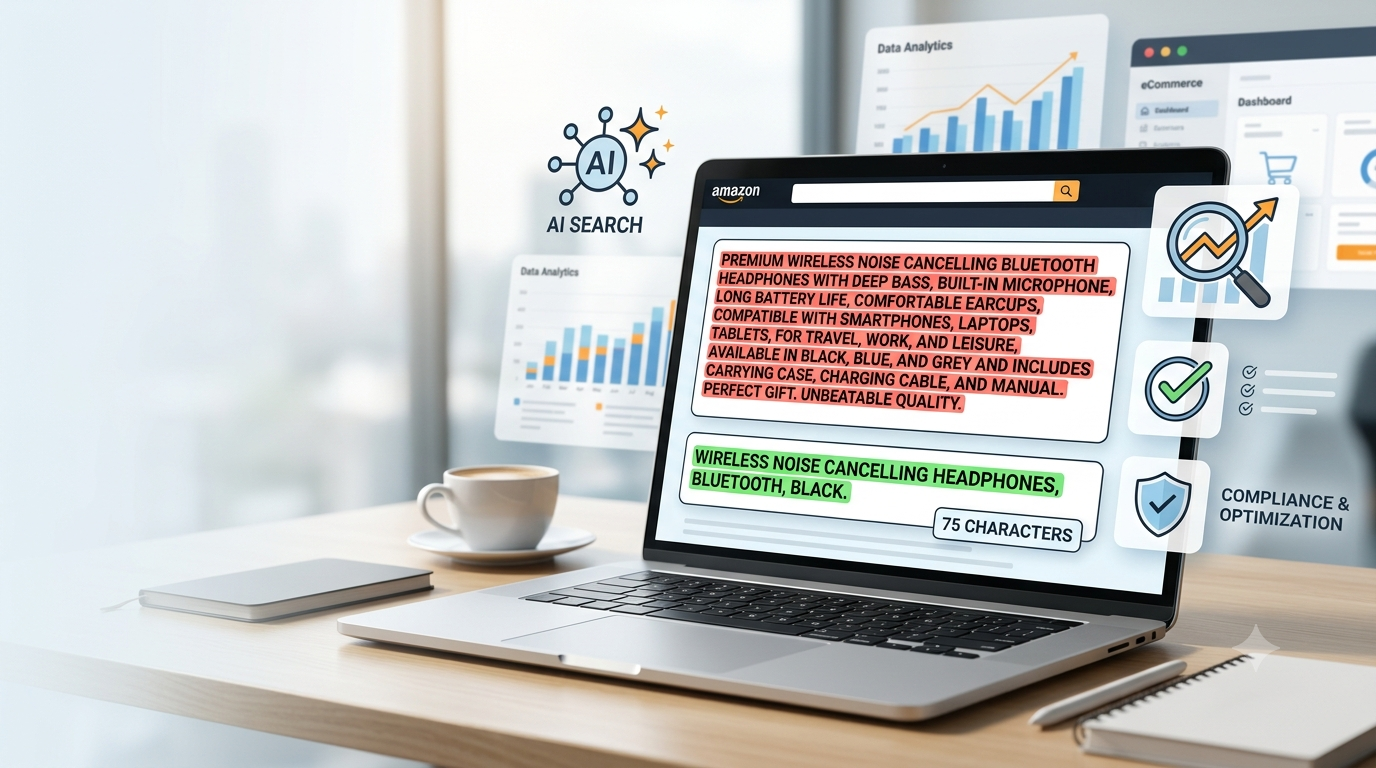
Amazon's 75-Character Product Title Rule: What Sellers Need to Fix Before Listings Lose Visibility
Introduction
Amazon continues to refine its marketplace standards, and the latest Amazon Title Rule is one of the most important updates sellers need to understand. As Amazon introduces a 75-character product title rule for many product categories, sellers must rethink how they write listing titles to remain compliant and competitive. Product titles are no longer just a place to add keywords—they're a critical factor in delivering a better shopping experience while supporting Amazon's search algorithm.
A well-optimized title helps shoppers quickly understand what a product is, improves click-through rates, and increases the likelihood of conversions. However, titles that exceed the allowed character limit or include unnecessary keyword stuffing may lose visibility, face suppression, or perform poorly in search results. Following the updated Amazon product title policy is now essential for maintaining strong rankings and ensuring listings remain eligible for maximum exposure.
In this guide, you'll learn what the new Amazon Title Rule means for sellers, why Amazon has introduced stricter listing title guidelines, and how the changes affect Amazon SEO. We'll also cover practical strategies for Amazon product title optimization, common mistakes to avoid, and the steps you should take now to keep your product listings compliant, searchable, and competitive in an increasingly crowded marketplace.
How the Amazon Title Rule Affects Search Rankings
The Amazon Title Rule does more than limit product titles to 75 characters. It also influences how products appear in search results, how shoppers interact with listings, and how Amazon's algorithm evaluates product quality. While the title itself is only one ranking factor, following Amazon's title guidelines can improve several performance metrics that contribute to long-term visibility.
Organic Search Visibility
Product titles remain one of the most important on-page elements for Amazon SEO. A clear, keyword-rich title helps Amazon understand what a product is and when it should appear in search results. Instead of stuffing multiple keywords into the title, sellers should focus on including the primary keyword naturally while placing additional searchable information in Item Highlights, bullet points, and product descriptions. Well-structured listings are more likely to maintain strong organic visibility over time.
Click-Through Rate (CTR)
The product title is one of the first elements shoppers see in search results. Shorter, easier-to-read titles allow customers to understand the product quickly, especially on mobile devices where screen space is limited. When shoppers can immediately identify the product, they are more likely to click on the listing, improving its click-through rate.
Conversion Rates
A clear and accurate title sets the right expectations before a customer visits the product page. When the title accurately describes the product without unnecessary keywords or promotional language, shoppers can make purchasing decisions with greater confidence. Higher relevance between the search query, product title, and listing content often leads to better conversion rates.
Buy Box Performance
Although product titles are not a direct Buy Box ranking factor, compliant and well-optimized listings contribute to overall listing quality. Amazon considers multiple performance signals, including customer experience, pricing, fulfillment, and listing quality. Following the Amazon Title Rule helps maintain a professional listing that supports overall marketplace performance.
AI Search and Rufus
Amazon's AI-powered shopping assistant, Rufus, relies on structured and accurate product information to answer customer questions and recommend products. Concise product titles combined with complete Item Highlights, bullet points, and product attributes provide clearer signals that help AI understand product features and match listings with relevant customer searches. Sellers who organize their product information effectively are better positioned for AI-driven product discovery.
Customer Trust
Customers are more likely to trust listings that present information clearly and professionally. Titles overloaded with repeated keywords or excessive promotional terms can appear misleading or difficult to understand. A concise, informative title improves readability, creates a better shopping experience, and builds confidence in the product. Increased customer trust can lead to higher engagement, more conversions, and stronger long-term sales performance.
What Happens If You Ignore the Amazon Title Rule?
Ignoring the Amazon Title Rule can negatively impact your product listings, reducing their visibility and overall sales performance. As Amazon continues to enforce stricter listing standards, non-compliant product titles may affect both the customer experience and your ability to compete effectively in search results.
One of the first consequences is lower search rankings. Titles that exceed Amazon's recommended character limit or contain excessive keyword stuffing may be considered less relevant, making it harder for your products to appear in prominent search positions.
Lower rankings often lead to reduced impressions. If fewer shoppers see your listings in search results, the number of potential clicks and sales opportunities also decreases. This reduced visibility can have a direct impact on your overall revenue.
Amazon may also issue catalog quality warnings for listings that do not comply with its product title guidelines. These notifications alert sellers that their titles require updates and encourage them to make corrections before further enforcement actions are taken.
In some cases, Amazon may automatically modify product titles to align with its catalog standards. While these changes help maintain consistency across the marketplace, they may remove important product details or alter your preferred title format, reducing your control over your listings.
For repeated or serious violations, Amazon can suppress affected listings until the title complies with the required guidelines. A suppressed listing becomes difficult or impossible for customers to purchase, resulting in lost sales until the issue is resolved.
Ultimately, non-compliant titles can also reduce conversion rates. Confusing, overly long, or keyword-heavy titles create a poor shopping experience, making customers less likely to click on your listing or complete a purchase. Keeping your titles clear, concise, and compliant helps protect visibility, maintain customer trust, and support long-term sales performance.
Common Mistakes That Violate the Amazon Title Rule
Many Amazon sellers unintentionally violate the Amazon Title Rule by trying to include too much information in their product titles. While adding keywords and product details may seem beneficial, overly long or poorly structured titles can reduce readability, create a poor customer experience, and increase the risk of non-compliance. The best approach is to write concise, informative titles that clearly describe the product while following Amazon's listing guidelines.
One of the most common mistakes is keyword stuffing. Some sellers repeat the same search terms several times in an attempt to improve Amazon SEO. Instead, use your primary keyword naturally and place additional relevant information in the Item Highlights, bullet points, or product description.
Another frequent issue is writing titles entirely in capital letters. ALL CAPS make listings harder to read and can appear unprofessional. Sentence case or title case creates a cleaner, more customer-friendly appearance.
Promotional phrases such as "Best Seller," "Limited Time Offer," "Free Shipping," or "100% Guaranteed" should also be avoided unless specifically permitted by Amazon. These statements do not describe the product itself and may violate listing policies.
Repeating brand names, product types, or keywords unnecessarily is another common mistake. Mention each important keyword only once unless repetition is required for clarity.
Many sellers also attempt to include every product feature in the title. Instead, reserve detailed specifications, materials, dimensions, compatibility, and benefits for bullet points and the product description. This keeps titles concise while still providing shoppers with complete information.
Finally, excessive punctuation, symbols, and special characters can make titles look cluttered and difficult to read. Clean formatting improves readability and creates a more professional product listing.
| Mistake | Better Alternative |
|---|---|
| Keyword stuffing | Use natural keywords that accurately describe the product. |
| ALL CAPS | Write titles in sentence case or title case for better readability. |
| Promotional phrases | Remove promotional claims and focus on product information. |
| Repeating keywords | Mention each important keyword only once where appropriate. |
| Too many features | Move detailed features, specifications, and benefits to bullet points. |
| Excessive punctuation | Keep titles clean by using only necessary punctuation and symbols. |
By avoiding these common mistakes, sellers can create titles that comply with the Amazon Title Rule while improving readability, customer trust, and long-term search performance.
Best Practices to Follow the Amazon Title Rule
Following the Amazon Title Rule is not just about meeting a character limit. It is about creating titles that help shoppers quickly understand your product while giving Amazon accurate information for search indexing. The following best practices will help you create compliant, readable, and high-performing product titles.
Place the Primary Keyword First
Start your title with the primary keyword or product type whenever possible. This helps Amazon understand the product quickly and allows customers to identify what you're selling at a glance. Ensure the keyword fits naturally rather than forcing it into the title.
Keep Titles Readable
Write titles that are clear, concise, and easy to scan. Avoid adding unnecessary words, repetitive phrases, or excessive specifications. A readable title improves the shopping experience, especially on mobile devices where only part of the title may be visible.
Mention Brand Name Once
Include your brand name only once in the title unless Amazon's category requirements state otherwise. Repeating the brand multiple times wastes valuable character space and can make the title appear spammy.
Include Important Product Details
Focus on the information customers need most, such as the product type, key feature, size, quantity, color, or model. Include only the most essential details in the title and move additional specifications, compatibility information, and product benefits to the bullet points or Item Highlights.
Avoid Keyword Stuffing
Use relevant keywords naturally instead of repeating the same search terms multiple times. Amazon's search algorithm understands product context better than before, so stuffing keywords into the title provides little value and may reduce readability.
Follow Category-Specific Guidelines
Although the 75-character rule applies to most non-media categories, some product categories may have additional title requirements. Always review your category's listing guidelines to ensure your titles comply with Amazon's latest policies and formatting standards.
Optimize for Mobile Shoppers
A growing percentage of Amazon purchases happen on smartphones. Since mobile devices display fewer characters, place the most important information at the beginning of the title. This ensures customers can understand your product without needing to expand the full listing.
Before-and-After Title Examples
| Before | After |
|---|---|
| Stainless Steel Water Bottle Water Bottle Sports Bottle Leak Proof BPA Free Bottle 1L Black Best Quality for Gym Outdoor Travel | EcoFlow Stainless Steel Water Bottle, Leak-Proof, 1L, Black |
| LED Desk Lamp Adjustable Lamp Desk Light Reading Lamp Office Lamp USB Rechargeable Touch Control Modern Study Lamp | BrightLite LED Desk Lamp, USB Rechargeable, Touch Control, Adjustable |
| Premium Cotton T Shirt Men's T Shirt Cotton Tee Casual Shirt Round Neck Comfortable Summer Wear Blue Large | UrbanWear Men's Cotton T-Shirt, Round Neck, Blue, Large |
These improved examples place the product type and brand at the beginning, eliminate repeated keywords, remove unnecessary promotional language, and highlight only the most important product attributes. This approach aligns with the Amazon Title Rule while improving readability, supporting Amazon SEO, and creating a better shopping experience for customers.
How to Update Your Listings for the Amazon Title Rule
Updating your product listings to comply with the Amazon Title Rule should be a structured process rather than simply shortening titles. A systematic review helps ensure your listings remain compliant while preserving search visibility and conversion potential. Use the following checklist to update your catalog efficiently.
Amazon Title Rule Checklist
Step 1: Audit Existing Product Titles
Review every product listing in your catalog and identify titles that may not comply with Amazon's latest title requirements. Prioritize your best-selling and highest-traffic products first.
Step 2: Identify Titles Exceeding the Recommended Length
Check which listings exceed Amazon's recommended 75-character limit. These products should be updated first to reduce the risk of catalog quality issues or reduced visibility.
Step 3: Remove Unnecessary Keywords
Eliminate repeated keywords, promotional phrases, excessive punctuation, and redundant product information. Keep only the keywords that accurately describe the product and support search relevance.
Step 4: Rewrite Titles Naturally
Create concise, readable titles that include the brand name, primary keyword, product type, and the most important product attributes. Avoid keyword stuffing and write titles that make sense to shoppers.
Step 5: Follow Amazon Category Style Guides
Review the title requirements for your specific product category. While the Amazon Title Rule applies broadly, certain categories may have additional formatting or attribute requirements.
Step 6: Test Updated Titles
After updating your listings, verify that titles display correctly on both desktop and mobile devices. Ensure the most important product information appears at the beginning of the title.
Step 7: Monitor Search Performance
Track your product rankings, impressions, and click-through rates after making changes. Compare performance before and after the update to identify any positive or negative trends.
Step 8: Review Conversion Rates
Continue monitoring conversion rates and sales performance over the following weeks. If a title update improves visibility but lowers conversions, consider refining the wording while remaining compliant with the Amazon Title Rule. Regular testing and optimization will help maintain strong search performance and provide a better shopping experience for customers.
Tools to Help You Comply with the Amazon Title Rule
Using the right tools can make it much easier to create compliant product titles while maintaining strong search performance. Both Amazon's built-in resources and third-party optimization platforms help sellers improve title quality, identify compliance issues, and optimize listings for better visibility.
Amazon Seller Central
Amazon Seller Central is the primary platform for managing product listings. Sellers can edit product titles, update listing information, and review Amazon's latest product title policies and category-specific requirements. It is the first place to implement title changes and ensure listings remain compliant.
Listing Quality Dashboard
The Listing Quality Dashboard helps sellers identify issues that may affect listing quality. It highlights missing product attributes, catalog improvements, and recommendations for optimizing listings. Reviewing this dashboard regularly can help sellers spot title-related issues before they impact product visibility.
Helium 10
Helium 10 offers powerful keyword research and listing optimization tools. Sellers can discover high-volume search terms, analyze competitors, and create product titles that include relevant keywords naturally without resorting to keyword stuffing. This helps improve Amazon SEO while complying with the Amazon Title Rule.
Jungle Scout
Jungle Scout provides keyword research, competitor analysis, and listing optimization features. It helps sellers identify the most important keywords shoppers use and incorporate them into concise, customer-friendly product titles that improve search visibility and click-through rates.
DataDive
DataDive uses search data and competitor analysis to identify the keywords that matter most. Instead of encouraging lengthy titles, it helps sellers prioritize high-value search terms and create optimized titles supported by real marketplace data, improving both compliance and discoverability.
Amazon Brand Analytics
Amazon Brand Analytics gives brand-registered sellers valuable insights into customer search behavior, top-performing search terms, and purchasing trends. These insights help sellers choose the most relevant keywords for their product titles and make data-driven optimization decisions that improve visibility and conversions.
By combining Amazon's native tools with trusted third-party platforms, sellers can create product titles that comply with the Amazon Title Rule while improving search rankings, customer experience, and long-term sales performance.
Need Help Optimizing Your Listings for the Amazon Title Rule?
Amazon policy updates can directly impact your product visibility, search rankings, and sales. Staying compliant with the Amazon Title Rule requires more than shortening your titles—it involves creating clear, keyword-optimized listings that enhance the customer experience and support long-term Amazon SEO performance.
At Palmetto Digital Marketing Group (PDMG), we help brands optimize product titles, improve listing quality, maintain compliance with Amazon's latest policies, and increase conversions through data-driven listing optimization strategies.
Contact our Amazon experts today to schedule a professional listing audit and discover how we can help you keep your product listings compliant, competitive, and optimized for maximum visibility and sales.