Amazon’s New 3.5% Fuel & Logistics Surcharge: What FBA Sellers Must Do Right Now to Protect Margins
The Amazon 3.5% fuel surcharge 2026 might look like a small update on the surface—but for most sellers, it’s a silent margin killer already in motion.
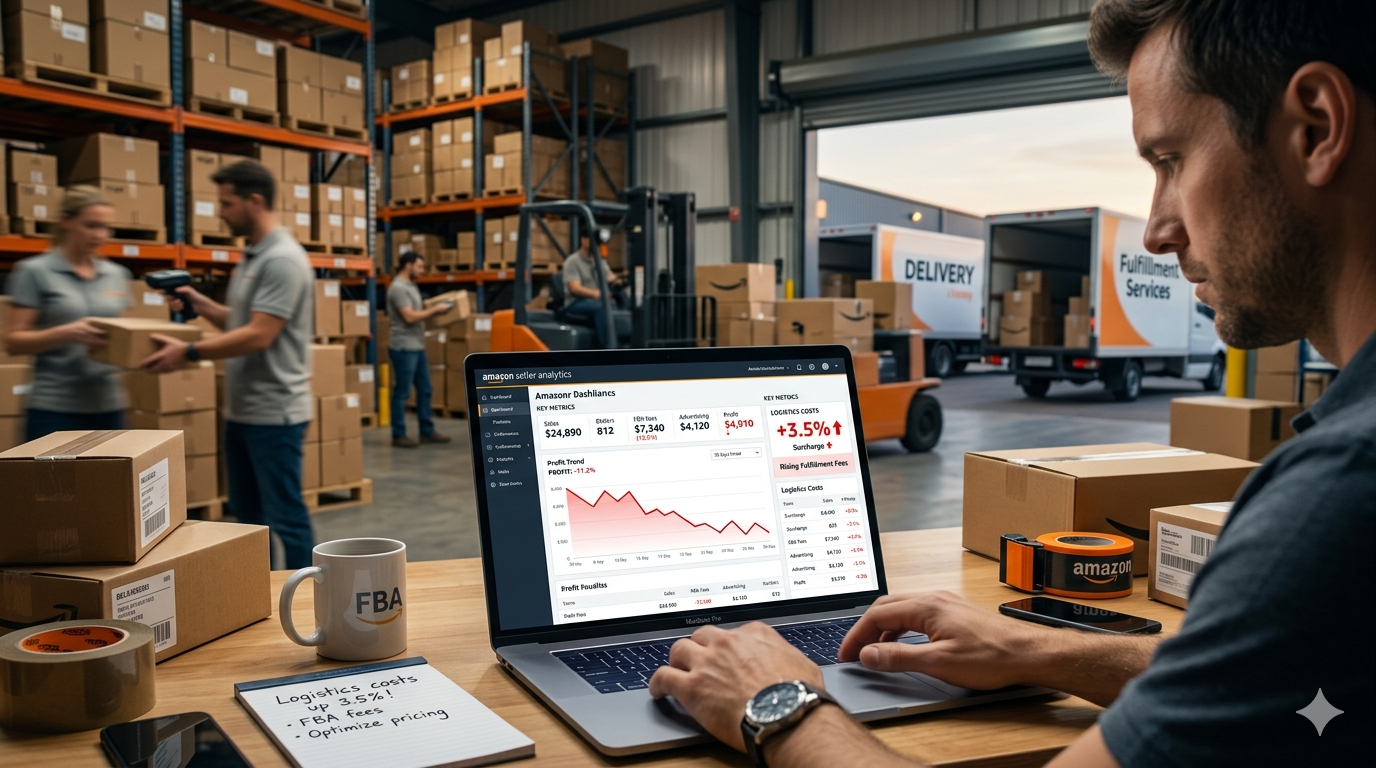
Starting April 17, 2026, Amazon has introduced a 3.5% fuel and logistics surcharge applied directly to FBA fulfillment fees. And within just a couple of weeks, from May 2, 2026, this increase expands further into Buy with Prime fees 2026 and Multi-Channel Fulfillment fees increase, making it clear that this is not a temporary adjustment—but a broader shift in Amazon’s cost structure.
At first glance, 3.5% doesn’t feel alarming. But here’s what most sellers underestimate: this surcharge doesn’t exist in isolation. It stacks on top of the existing Amazon FBA fee increase 2026, rising storage costs, higher advertising spend, and already shrinking margins. The real impact is not 3.5%—it’s the compounded pressure across your entire business model.
For sellers running on thin margins, this change can quietly turn profitable products into break-even—or even loss-making—SKUs almost overnight. And the worst part? You may not even notice it immediately. Instead, you’ll see a gradual dip in your Amazon seller profit margins, rising fulfillment costs, and reduced cash flow—without a clear reason why.
This is exactly how Amazon fee changes affect most sellers—not through sudden shocks, but through slow, compounding impact.
Right now, there are two types of sellers: those who ignore this update and watch their profits shrink over the next few months, and those who take action early, adjust their pricing, optimize costs, and stay ahead of the curve.
If you’re unsure how this will affect your catalog—or how to respond—you’re not alone. Most sellers are still trying to figure out the real Amazon logistics surcharge impact and what it means for their business going forward.
So before this fee quietly eats into your margins, it’s critical to understand what’s actually changing, how much it will cost you per unit, and most importantly—what you should do right now to protect your profitability.
Here’s exactly what’s changing—and what you need to do immediately.
What Exactly Is the 3.5% Surcharge?
The Amazon 3.5% fuel surcharge 2026 is a newly introduced cost adjustment applied to Amazon’s fulfillment and logistics operations, designed to offset rising expenses in transportation, fuel, and supply chain management. In simple terms, Amazon is passing a portion of its increasing operational costs directly onto sellers.
This surcharge is primarily applied to FBA fulfillment fees, meaning every unit you store, pick, pack, and ship through Amazon will now carry an additional 3.5% cost layer. While it may not be explicitly labeled as a separate line item in all reports, it is embedded into the broader Amazon fulfillment cost increase, making it harder for sellers to immediately identify its true impact.
The reason behind this change is clear: global fuel prices, inflation, and ongoing supply chain pressures have significantly increased logistics costs over the past few years. Amazon, like other logistics-heavy companies, is adjusting its pricing structure to maintain operational efficiency and profitability.
What makes this update more important is its expansion beyond FBA. Starting May 2, 2026, this surcharge also applies to:
1. Buy with Prime fees 2026
2. Multi-Channel Fulfillment fees increase
This means even sellers who rely on Amazon for off-platform fulfillment are not exempt from the impact.
Here’s the critical point most sellers overlook: this is not a one-time fee or temporary spike. It’s an ongoing cost layer that will continuously affect your per-unit economics, pricing strategy, and overall Amazon seller profit margins.
Understanding this early is key—because once it compounds across thousands of orders, the impact becomes impossible to ignore.
Which Fees Are Actually Affected?
The Amazon 3.5% fuel surcharge 2026 is not limited to a single fee category—it is layered across Amazon’s entire fulfillment infrastructure, which makes its real impact much deeper than most sellers initially assume. While Amazon hasn’t positioned it as a dramatic structural change, in practice, it increases the overall cost of moving every unit through its network. This is why many sellers are already seeing subtle shifts in their Amazon seller profit margins without immediately connecting it to this update.
Impact on Core FBA Fulfillment Fees
At the foundation level, the surcharge directly affects your core FBA fees April 2026, which include the essential services Amazon provides to deliver your product to the end customer. This means your pick & pack fees, weight handling charges, and shipping costs are all now slightly more expensive.
Individually, these increases may seem small. But when applied to every unit sold, the additional 3.5% compounds quickly—especially for high-volume sellers. For example, if your product already operates on tight margins, even a marginal increase in fulfillment costs can push it from profitable to break-even. This is how the broader Amazon FBA fee increase 2026 quietly impacts sellers—not through a single large jump, but through consistent cost layering across every order.
Expansion into Extended Fulfillment Services
The impact becomes even more significant when you consider Amazon’s extended ecosystem. The surcharge is not limited to marketplace orders—it also applies to Multi-Channel Fulfillment fees increase and Buy with Prime fees 2026.
This means that even if you are trying to diversify your revenue streams through Shopify or your own website, you are still exposed to the same Amazon fulfillment cost increase if you rely on Amazon’s logistics network. In other words, the cost pressure follows you beyond Amazon’s marketplace, making it harder to escape rising fulfillment expenses.
The Hidden Impact Most Sellers Miss
Where the real damage happens, however, is in the secondary and often overlooked cost areas. The Amazon logistics surcharge impact extends indirectly into processes like returns handling and inventory storage.
When a product is returned, the cost of processing, inspecting, and restocking that unit also becomes more expensive due to higher logistics costs. Similarly, if your inventory sits longer in Amazon’s warehouses, the increased cost structure makes holding aged inventory even more expensive over time.
This is the layer most sellers ignore. They focus only on visible fee changes, but fail to account for how these “hidden costs” compound across operations. Over weeks and months, this leads to a gradual but consistent decline in profitability.
This is why the 3.5% surcharge is more than just a fee—it’s a multiplier across your entire cost structure.
The Real Impact: How Much Are You Actually Losing?
The Amazon 3.5% fuel surcharge 2026 may sound like a small percentage increase—but when you break it down at the unit level and combine it with your full cost structure, the real impact is far more aggressive than most sellers expect. This is where understanding how to calculate FBA fees properly becomes critical.
A Real-World Profit Breakdown
Let’s take a simple product example to understand the true Amazon logistics surcharge impact:
1. Selling Price: $25
2. FBA Fulfillment Fee: $8
3. 3.5% Surcharge on FBA Fee: $0.28 per unit
At first glance, losing $0.28 doesn’t seem like a big deal. But that’s only looking at one piece of the puzzle.
Now layer in the rest of your costs:
1. Amazon Referral Fee (~15%): $3.75
2. PPC/Advertising Cost (average): $5
3. Product Cost (COGS): $4.05
Before the surcharge, your profit looked something like this:
$25 – ($8 + $3.75 + $5 + $4.05) = $4.20 profit per unit
After applying the surcharge:
$25 – ($8.28 + $3.75 + $5 + $4.05) = $3.92 profit per unit
The Hidden Margin Erosion
Now here’s the insight most sellers miss:
You didn’t just lose 3.5%—your profit dropped from $4.20 to $3.92.
That’s a ~7% drop in profit, not 3.5%.
And this is exactly how the Amazon FBA fee increase 2026 impacts your business—it amplifies across your entire cost stack. When your margins are already tight, even small increases in fulfillment costs create a disproportionate hit on profitability.
Why This Matters for Scaling Sellers
If you’re selling 1,000 units per month, that’s a direct loss of $280 monthly—without changing anything in your business. Scale that to 10,000 units, and you’re suddenly losing thousands in profit due to a change that seemed “minor.”
This is why many sellers are already seeing pressure on their Amazon seller profit margins and struggling to maintain consistent profitability.
The key takeaway? The surcharge is not just a cost increase—it’s a margin multiplier working against you.
How to Calculate the Impact on Your Catalog (Step-by-Step)
Understanding the true impact of the Amazon 3.5% fuel surcharge 2026 requires more than just looking at one product—you need to analyze your entire catalog. Most sellers underestimate how this change affects different SKUs differently, which is why a structured approach is essential if you want to protect your Amazon seller profit margins.
Step-by-Step Calculation Process
The first step is to export your FBA fee report from Seller Central. This report gives you a clear breakdown of your current fulfillment costs for each SKU, including pick & pack, weight handling, and shipping fees. Without this data, it’s impossible to accurately measure the Amazon fulfillment cost increase.
Once you have the data, the next step is to apply the 3.5% surcharge to your fulfillment fees. This means simply multiplying your current FBA fee per unit by 0.035. This gives you the additional cost per unit, which may seem small individually but becomes significant at scale.
After that, you need to recalculate your per-unit economics. Add this surcharge to your existing costs and update your total expense per product. This is where many sellers realize that their margins are thinner than expected.
Identifying High-Risk Products
The most critical step is to recalculate your contribution margin for every SKU. This means subtracting all costs—FBA fees, referral fees, PPC spend, and product cost—from your selling price.
Once updated, you can clearly identify:
1. Low-margin SKUs that are now barely profitable
2. Break-even products that generate no real profit
3. Loss-making SKUs that are silently draining your business
This is where the real insight lies. The Amazon logistics surcharge impact is not equal across your catalog—some products will absorb it easily, while others will become completely unsustainable.
Use Tools to Simplify the Process
Doing this manually can be overwhelming, especially if you have a large catalog. That’s why it’s highly recommended to use spreadsheets or profitability tools to automate calculations. A simple Excel sheet with formulas can quickly show you the before-and-after margin comparison, while advanced tools can give deeper insights into trends and risks.
If you’re unsure how this affects your catalog, this is the step that reveals everything.
Immediate Actions Sellers Should Take
The Amazon 3.5% fuel surcharge 2026 is not something you can afford to ignore or “wait and watch.” By the time you feel the impact in your profits, the damage is already done. This is where smart sellers separate themselves—by acting early and adjusting their strategy before margins start slipping.
Most sellers are already seeing margin drops due to the Amazon FBA fee increase 2026, but only a few are taking structured action. Here’s exactly what you should do right now to protect—and even improve—your profitability.
Adjust Pricing Strategically (Without Killing Conversions)
The most immediate response is pricing—but this is also where most sellers make mistakes. Instead of making aggressive price jumps, focus on small, controlled increases in the range of ₹40–₹80 (or $0.50–$1).
This allows you to recover some of the Amazon fulfillment cost increase without hurting your conversion rate. Sudden price hikes can reduce sales velocity, which then negatively impacts ranking and organic traffic.
A smarter approach is to test pricing changes gradually. Use A/B testing (or manage variations over time) to find the sweet spot where you maintain conversions while improving margins. This is a key part of an effective Amazon pricing strategy after fee increase.
Cut Low-Margin and Underperforming SKUs
Not every product deserves to stay in your catalog—especially after this surcharge.
You need to identify and eliminate products that fall below a 15–20% profit margin after recalculating costs. These SKUs may still generate sales, but they contribute little to actual profit—and in many cases, they quietly become loss-making after the surcharge.
Focusing on profitability over volume is critical. A smaller catalog with strong margins will always outperform a large catalog with weak economics.
Optimize Packaging (The Most Ignored Lever)
One of the most underrated ways to reduce the Amazon logistics surcharge impact is packaging optimization.
Since FBA fees are heavily influenced by weight and dimensions, even small reductions in packaging size or weight can move your product into a lower fee tier. This directly reduces your base fulfillment cost—and therefore the 3.5% surcharge applied on top of it.
Most sellers ignore this because it requires operational effort, but the impact can be significant, especially for high-volume products.
Improve PPC Efficiency to Recover Lost Margin
With rising costs, your advertising strategy becomes even more important. If your ACOS is already high, this surcharge will amplify your losses.
Focus on:
1. Reducing wasted ad spend
2. Prioritizing high-converting keywords
3. Pausing underperforming campaigns
Improving PPC efficiency directly offsets the increase in Amazon seller profit margins pressure. Even a small improvement in ACOS can recover more than what you’re losing from the surcharge.
Negotiate Better Supplier Deals
If you can’t fully control Amazon’s fees, you need to optimize what you can control—your product cost.
This is the right time to renegotiate with suppliers for:
1. Bulk discounts
2. Better pricing terms
3. Lower manufacturing costs
Improving margins at the source gives you more flexibility to absorb rising fulfillment costs without sacrificing profitability.
Consider a Hybrid Fulfillment Strategy
Finally, don’t rely entirely on Amazon’s logistics.
Explore a hybrid model combining FBA + FBM (Fulfilled by Merchant). This allows you to reduce dependency on Amazon’s fulfillment network and potentially lower costs for certain products or regions.
For some SKUs, especially bulky or low-margin ones, FBM can be more cost-effective even after factoring in shipping.
Advanced Strategy: Turn This Into an Advantage
The Amazon 3.5% fuel surcharge 2026 is going to hurt most sellers—but not all. The difference comes down to how quickly and intelligently you respond.
Here’s the reality: most sellers will react late. They’ll either ignore the update or respond emotionally by increasing prices across the board. That creates a massive opportunity for sellers who think strategically instead of reactively.
When competitors blindly raise prices to offset the Amazon FBA fee increase 2026, they often damage their conversion rates. Higher prices without added value lead to lower sales velocity, weaker rankings, and ultimately less visibility. This is where you can step in and win.
One approach is to maintain your current pricing while optimizing your backend costs—through better PPC efficiency, packaging optimization, or supplier negotiations. By doing this, you absorb the Amazon logistics surcharge impact more efficiently than competitors, allowing you to keep prices stable and gain market share while others lose momentum.
Alternatively, if you do need to increase prices, do it strategically with better positioning, not just cost recovery. Instead of selling a single product, consider bundling complementary items to increase perceived value. This allows you to justify a higher price while maintaining strong conversion rates.
You can also shift toward premium branding—better images, stronger copy, enhanced A+ content, and clearer differentiation. Customers are far more willing to accept higher prices when they perceive higher value.
This is the key shift: average sellers adjust prices… smart sellers adjust positioning.
In a market where most are reacting to cost pressure, the sellers who optimize smarter will not just survive the Amazon fee increase strategy for sellers—they’ll come out ahead.
Common Mistakes to Avoid
The Amazon 3.5% fuel surcharge 2026 is already creating a gap between sellers who act strategically and those who make reactive mistakes. And the truth is—most losses won’t come from the surcharge itself, but from how sellers respond to it.
One of the biggest mistakes is ignoring the update completely. Many sellers assume, “It’s just 3.5%,” and continue business as usual. But as we’ve seen, the real Amazon logistics surcharge impact compounds across multiple costs, turning a small percentage into a significant drop in Amazon seller profit margins over time.
Another common error is increasing prices too aggressively. While adjusting pricing is necessary, sudden jumps can hurt conversion rates, reduce sales velocity, and negatively impact rankings. This often creates a bigger problem than the Amazon FBA fee increase 2026 itself.
Many sellers also fail to recalculate their full cost structure, especially PPC spend. Ignoring ad costs while adjusting for fulfillment fees gives an incomplete picture, leading to poor decision-making and shrinking margins.
Keeping low-performing or dead SKUs is another silent profit killer. Products that were barely profitable before can quickly become loss-making after the surcharge.
Finally, over-relying on FBA without exploring alternatives like FBM limits your flexibility. In a rising cost environment, depending entirely on one fulfillment channel increases risk.
Avoiding these mistakes is just as important as taking the right actions.
Final Takeaway
The Amazon 3.5% fuel surcharge 2026 is not just another small fee update—it represents a real margin reset moment for sellers. It’s forcing a shift from growth-focused selling to profit-focused decision-making, where every cost, every SKU, and every strategy matters more than ever. Sellers who take the time to understand the true Amazon logistics surcharge impact, optimize their pricing, reduce inefficiencies, and control their costs will not only survive this change—they will position themselves to grow stronger in a more competitive environment shaped by rising Amazon fulfillment cost increase.
On the other hand, those who ignore it or delay action will slowly see their Amazon seller profit margins shrink. Their products may continue to sell, but profitability will decline quietly over time, turning strong-performing SKUs into break-even or even loss-making ones. This is how most sellers lose in today’s market—not through sudden failure, but through gradual erosion of margins.
Ultimately, the sellers who win in the era of the Amazon FBA fee increase 2026 will be the ones who adapt early and think strategically about every cost decision.
In 2026, winning on Amazon isn’t about selling more—it’s about protecting every dollar of margin.
CTA (Agency-Focused)
If you’re unsure how the Amazon 3.5% fuel surcharge 2026 is impacting your catalog, this is exactly where expert guidance makes the difference. Most sellers don’t realize how deeply the Amazon logistics surcharge impact affects their margins until profits start slipping—and by then, it’s already costing them. We help sellers break down their numbers, identify hidden losses, and build a clear action plan to protect and improve profitability. From detailed margin audits to data-driven pricing strategy adjustments and complete FBA cost optimization, the goal is simple: help you keep more from every sale. If you want clarity on your real margins—and a strategy tailored to your products—we’ll walk you through it step by step.