Amazon Listing Title Rules 2026: What Sellers Can No Longer Say and How to Fix Listings
Introduction
If you're selling on Amazon in 2026, there's a high chance you're breaking title rules without even realizing it.
Amazon has significantly tightened its listing policies, especially around product titles. What used to work a year ago—like keyword stuffing, exaggerated claims, or promotional phrases—can now get your listing suppressed or even flagged for policy violations.
The scary part? Many sellers don’t notice the impact immediately. Your product might just start losing visibility, rankings, and conversions without any clear warning. In more serious cases, repeated violations can lead to account warnings or listing removal.
That’s why understanding Amazon Listing Title Rules 2026 is no longer optional—it’s essential for survival and growth on the platform.
In this guide, you’ll learn exactly what has changed, which words and practices are now banned, and how to fix your existing titles to stay compliant. More importantly, you’ll discover how to rewrite your product titles in a way that is both policy-safe and optimized for conversions.
Let’s break it down before Amazon does it for you.
Amazon Listing Title Rules 2026 – What Has Changed?
Amazon has introduced stricter and more structured guidelines for product titles in 2026, signaling a clear shift toward improving customer experience and platform trust. The updated rules focus on making titles more readable, accurate, and informative rather than overloaded with keywords. Earlier, many sellers relied heavily on keyword stuffing and promotional language to rank higher in search results. However, Amazon now prioritizes clarity, relevance, and compliance over aggressive optimization tactics.
The reason behind this shift is straightforward. Amazon wants to ensure that customers can quickly understand what a product is without being misled by exaggerated claims or cluttered titles. Misleading phrases, unnecessary symbols, and repeated keywords often created confusion and reduced trust. By tightening these policies, Amazon aims to standardize listings across the platform, reduce manipulation of search algorithms, and ultimately improve conversion rates through better user experience.
Character Limits and Formatting Rules
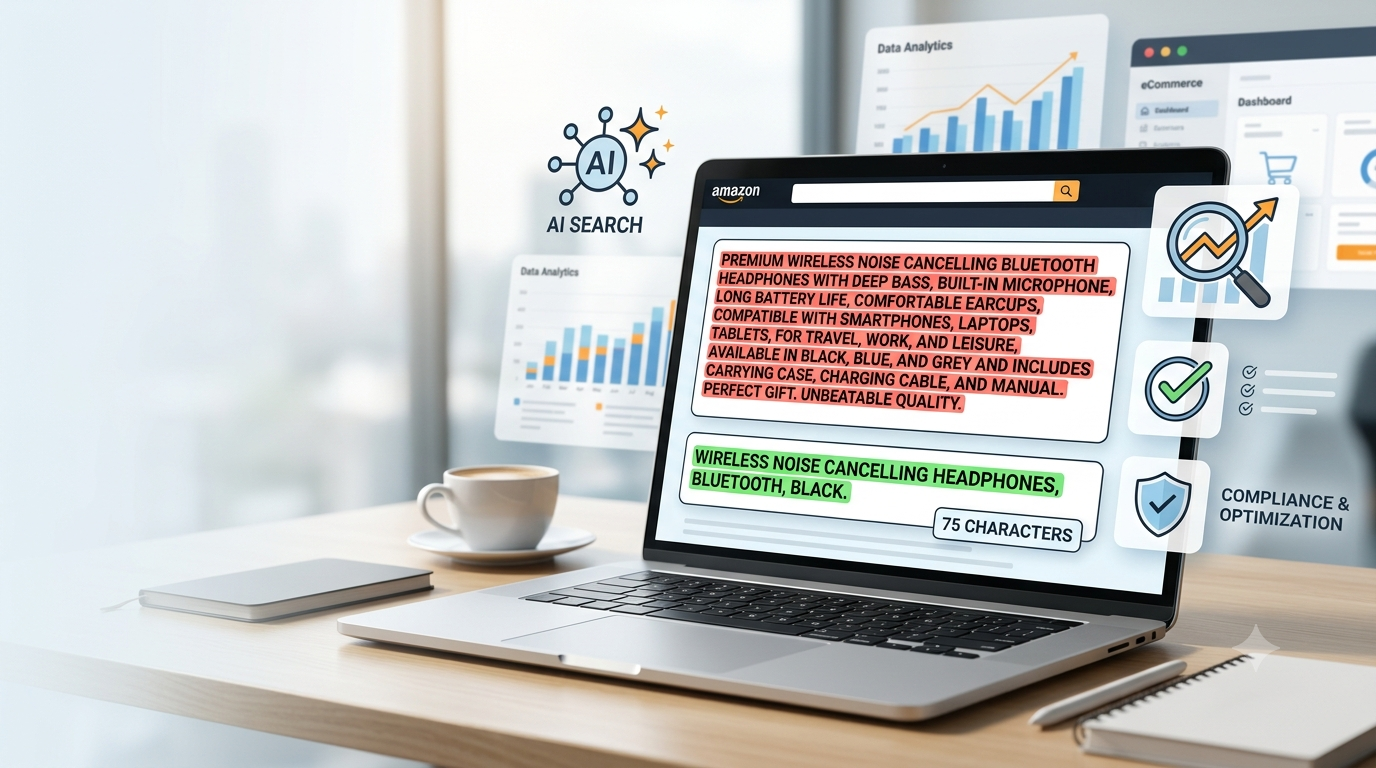
One of the most important updates under Amazon Listing Title Rules 2026 is the enforcement of stricter character limits. While the exact limit may vary by category, most product titles are expected to stay within the range of 150 to 200 characters. Sellers who exceed this limit risk having their titles truncated or their listings suppressed altogether.
Formatting has also become more regulated. The use of all capital letters is no longer allowed, except for certain abbreviations or brand names where appropriate. Titles must follow proper capitalization rules, typically using sentence case or title case depending on category guidelines. Random capitalization, excessive punctuation, and the use of symbols purely for attention-grabbing are now considered non-compliant.
Keyword Usage Under Amazon Listing Title Rules 2026
Keyword strategy has undergone a major transformation. Amazon now discourages repetition of the same keywords within a title. Instead of repeating similar terms to increase visibility, sellers are expected to use keywords naturally and only where they add value.
Keyword stuffing is strictly prohibited. Titles should not feel forced or overloaded with search terms. Instead, the focus should be on readability and relevance. A well-structured title that clearly communicates the product’s key features, brand, and purpose will perform better than one packed with redundant keywords.
Under Amazon Listing Title Rules 2026, the goal is to strike a balance between optimization and user experience. Sellers who prioritize clarity and meaningful keyword placement will not only stay compliant but also see better long-term performance in search rankings and conversions.
Banned Words in Amazon Listing Title Rules 2026
One of the biggest changes in Amazon Listing Title Rules 2026 is the strict enforcement of banned words and phrases. Amazon is actively removing or suppressing listings that use manipulative, misleading, or overly promotional language in product titles. The goal is to maintain a clean, trustworthy marketplace where customers can rely on accurate product information rather than exaggerated claims.
Sellers who continue using outdated tactics—such as hype-driven phrases or attention-grabbing symbols—risk losing visibility or facing compliance actions. Understanding what is no longer allowed is critical if you want your listings to remain active and competitive.
Promotional & Salesy Words You Can’t Use
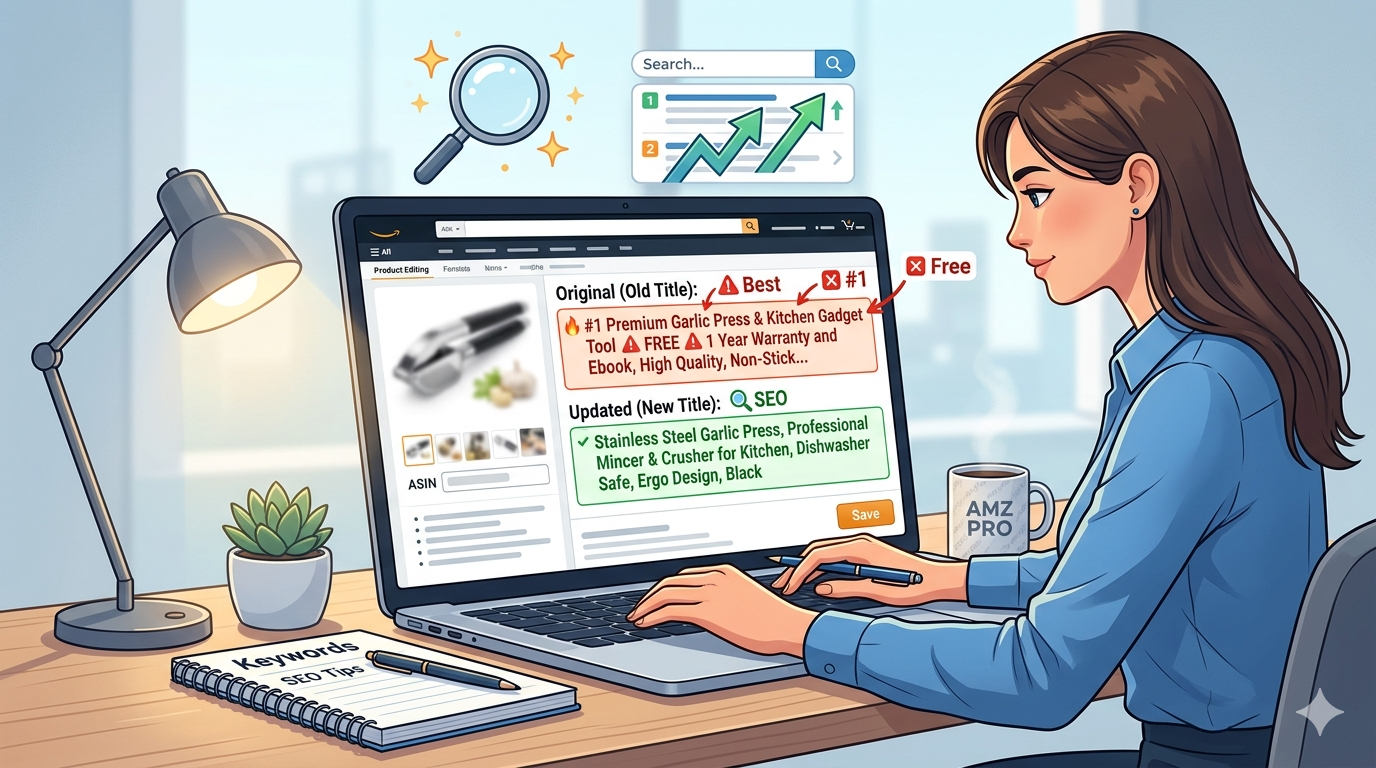
Amazon has clearly restricted the use of promotional and sales-driven language in product titles. Words and phrases like “Best Seller,” “#1 Product,” “Free Shipping,” and “Discount” are no longer allowed.
These terms are considered misleading because they either make unverifiable claims or attempt to influence buying decisions artificially. For example, calling a product “#1” without official verification creates false authority, while mentioning “Free Shipping” is unnecessary since shipping details are already handled within Amazon’s system.
Under Amazon Listing Title Rules 2026, titles must remain factual and product-focused rather than promotional. The emphasis is on describing what the product is, not selling it through exaggerated claims.
Restricted Claims & Misleading Statements
Another major restriction applies to claims that cannot be universally verified. Phrases such as “100% Guaranteed,” “Clinically Proven,” or “FDA Approved” are strictly regulated.
Unless you have proper documentation and approval from Amazon for such claims, including them in your title can lead to immediate suppression. This is especially important in categories like health, wellness, and beauty, where misleading claims can have serious consequences.
Amazon’s algorithm now actively scans for these types of statements to ensure that all listings meet compliance standards. Sellers must ensure that every word in their title is accurate, verifiable, and aligned with Amazon’s policies.
Symbols, Emojis & Special Characters Restrictions
Amazon has also limited the use of symbols and special characters in product titles. Excessive use of punctuation or decorative symbols such as “!!!”, “$$$”, or “★★★” is no longer allowed.
These elements were often used in the past to grab attention, but they now negatively impact readability and user experience. Titles should look clean, professional, and easy to understand at a glance.
Only minimal and necessary punctuation is permitted, such as hyphens or commas used to separate product attributes. The use of emojis is completely restricted in titles.
As per Amazon Listing Title Rules 2026, simplicity and clarity are key. A well-structured title without unnecessary symbols not only ensures compliance but also builds trust with potential buyers.
Common Mistakes Sellers Make (Violating Amazon Listing Title Rules 2026)
Even in 2026, many sellers continue to make critical mistakes that directly violate Amazon Listing Title Rules 2026—often without realizing it. These mistakes usually come from outdated SEO practices or the urge to maximize visibility at any cost.
One of the most common issues is keyword stuffing, where sellers overload titles with repeated or similar keywords in an attempt to rank higher. This not only hurts readability but also signals low-quality content to Amazon’s algorithm. Another frequent mistake is overpromising benefits by using exaggerated claims that cannot be verified, which directly violates Amazon’s compliance policies.
Some sellers also try to include competitor brand names in their titles to capture traffic. This is strictly prohibited and can lead to serious penalties, including listing removal. Lastly, many titles are written purely for SEO, ignoring the human element. While keywords are important, titles must still be clear, natural, and easy for customers to understand.
Real Example of a Bad Title
Incorrect Title:
“Best Seller Wireless Earbuds Bluetooth Earbuds Noise Cancelling Earbuds for iPhone Samsung Android Free Shipping 100% Guaranteed!!!”
Why It Violates Amazon Listing Title Rules 2026
This title breaks multiple rules under Amazon Listing Title Rules 2026, and here’s a clear breakdown of why:
- “Best Seller” – This is a promotional claim that is not allowed unless officially verified by Amazon. It creates misleading authority.
- “Wireless Earbuds Bluetooth Earbuds Noise Cancelling Earbuds” – This is a classic case of keyword stuffing. The same keyword is repeated multiple times unnecessarily, reducing readability.
- “for iPhone Samsung Android” – While compatibility can be mentioned, stuffing multiple brand names in a cluttered way reduces clarity and may raise compliance concerns if not formatted properly.
- “Free Shipping” – Shipping information is managed by Amazon and should not be included in the title.
- “100% Guaranteed” – This is an unverifiable claim and falls under restricted statements.
- “!!!” – Excessive punctuation violates formatting guidelines and looks unprofessional.
Overall, this title is written for search engines rather than customers. It is cluttered, repetitive, and filled with banned elements. Under Amazon Listing Title Rules 2026, such a title would likely be suppressed or require immediate correction.
The key takeaway is simple: if your title looks forced, overly promotional, or difficult to read, it’s probably not compliant.
How to Write Compliant Titles Under Amazon Listing Title Rules 2026
Now that you know what NOT to do, the next step is understanding how to create titles that are both compliant and high-performing. Under Amazon Listing Title Rules 2026, success comes from balancing clarity, structure, and smart keyword usage—without falling into the trap of over-optimization.
A well-written title not only keeps you safe from policy violations but also improves click-through rates and conversions. The goal is simple: make your product easy to understand while naturally aligning with what customers are searching for.
Ideal Amazon Title Structure (Formula)
To stay compliant and effective, follow a clean and consistent structure when writing your titles. A commonly recommended format is:
Brand + Product Type + Key Feature + Size/Variant + Use Case
For example:
“SoundCore Wireless Earbuds with Noise Cancellation, 20H Battery Life, Black, for Travel & Work”
This structure ensures that your title is informative, organized, and easy to scan. It also helps Amazon’s algorithm understand your product without needing excessive keywords or repetition.
Balance Between Keywords and Readability
One of the biggest shifts in Amazon Listing Title Rules 2026 is the importance of readability. Titles should be written for humans first, not search engines.
If your title sounds unnatural or forced, it’s likely over-optimized. Instead of cramming in every possible keyword, focus on making the title flow naturally. A clear and concise title improves user experience, which ultimately leads to better engagement and conversions.
Once your title reads well, you can refine it by ensuring your most important keywords are included in a natural way. Think of SEO as supporting readability—not replacing it.
Use of Primary & Secondary Keywords
Effective keyword placement is still important, but it must be done strategically. Your primary keyword—the main term customers are searching for—should appear near the beginning of the title. This helps both visibility and relevance.
Secondary keywords should be included naturally throughout the title, without repetition or forced phrasing. These can highlight additional features, variations, or use cases that add value to the listing.
Under Amazon Listing Title Rules 2026, the focus is no longer on how many keywords you can fit, but how well you can integrate them. A clean, keyword-rich title that reads naturally will always outperform a cluttered one.
How to Fix Existing Listings (Step-by-Step Guide)
If your current listings are not aligned with Amazon Listing Title Rules 2026, the good news is that they can be fixed with a clear, structured approach. Instead of guessing what to change, follow this step-by-step process to turn non-compliant titles into optimized, high-converting ones.
Step 1 – Audit Your Current Title
Start by reviewing your existing product title critically. Look for any elements that violate Amazon’s updated guidelines.
Check for banned or promotional words such as “Best Seller,” “Free Shipping,” or exaggerated claims. Then identify if your title suffers from keyword stuffing—repeated or unnecessary keywords that make the title look cluttered.
Also, read your title from a customer’s perspective. If it feels hard to understand or overly packed, it likely needs refinement. This audit step helps you clearly identify what needs to be fixed before making changes.
Step 2 – Remove Non-Compliant Elements
Once you’ve identified the issues, begin by stripping out all non-compliant elements.
Remove any promotional phrases, unverifiable claims, or unnecessary symbols. Eliminate repeated keywords and reduce clutter. This step is about cleaning your title completely, even if it temporarily becomes shorter or less optimized.
Think of this as resetting your title to a clean and compliant foundation before rebuilding it the right way.
Step 3 – Rewrite Using Amazon Listing Title Rules 2026
Now, rebuild your title using a structured and compliant format. Follow the proven formula:
Brand + Product Type + Key Feature + Size/Variant + Use Case
Focus on clarity and logical flow. Make sure your primary keyword appears naturally at the beginning, and include secondary keywords only where they add real value.
Avoid forcing keywords into the title. Instead, ensure every word contributes to helping the customer understand the product better. This is where compliance and SEO come together effectively.
Step 4 – Optimize for CTR and Conversion
Finally, refine your title to improve click-through rate (CTR) and conversions.
Add clarity by making the product’s purpose immediately obvious. Highlight specific features that matter to buyers, such as material, size, compatibility, or key benefits. These details help your product stand out in search results without violating any rules.
A strong, compliant title under Amazon Listing Title Rules 2026 is not just about avoiding penalties—it’s about making your product more appealing, trustworthy, and easy to choose.
Before vs After Title Examples (Amazon Listing Title Rules 2026)
One of the best ways to understand Amazon Listing Title Rules 2026 is by comparing real examples. Below are clear before-and-after transformations that show how non-compliant, low-quality titles can be rewritten into clean, optimized, and policy-safe versions.
These examples highlight the shift from hype-driven, keyword-stuffed titles to structured, informative, and conversion-friendly ones.
Example 1
Old Title:
“Best Wireless Earbuds!!! 50% OFF Premium Quality”
New Title:
“BrandX Wireless Earbuds with Noise Cancellation, Bluetooth 5.3, 24H Battery”
What Changed and Why It Works:
The old title uses banned promotional phrases like “Best” and “50% OFF,” along with excessive punctuation. It also lacks specific product details.
The new title follows a proper structure under Amazon Listing Title Rules 2026. It includes the brand name, product type, key features (noise cancellation, Bluetooth version), and a measurable benefit (24-hour battery). The result is a clean, informative, and trustworthy title that improves both compliance and conversions.
Example 2
Old Title:
“100% Guaranteed Hair Growth Oil Fast Results”
New Title:
“Herbal Hair Oil with Natural Ingredients for Scalp Care, 200ml”
What Changed and Why It Works:
The old title makes exaggerated and unverifiable claims like “100% Guaranteed” and “Fast Results,” which violate Amazon’s policies.
The new version removes all misleading claims and focuses on factual, descriptive elements. It highlights the product type (hair oil), key feature (natural ingredients), use case (scalp care), and size (200ml). This aligns perfectly with Amazon Listing Title Rules 2026, making the title both compliant and customer-friendly.
Pro Tips to Stay Compliant Long-Term
Staying compliant with Amazon Listing Title Rules 2026 is not a one-time fix—it’s an ongoing process. Amazon frequently updates its policies, and sellers who stay proactive are the ones who maintain rankings, avoid penalties, and build sustainable businesses.
One of the most important habits is to regularly check for Amazon policy updates. Guidelines can change based on category trends, customer behavior, or regulatory requirements. Staying informed ensures that your listings remain compliant and competitive over time.
It’s also essential to follow category-specific rules. Different product categories often have unique requirements for title length, formatting, and allowed terminology. What works for electronics may not be acceptable in beauty or health categories. Always align your titles with the specific guidelines of your niche.
Another key tip is to avoid shortcuts. Tactics like keyword stuffing, exaggerated claims, or copying competitor strategies might offer short-term gains, but they often lead to long-term risks. Amazon’s system is becoming smarter, and non-compliant listings are quickly identified and penalized.
Finally, focus on long-term brand building rather than quick wins. A clean, consistent, and trustworthy listing not only keeps you compliant but also builds credibility with customers. When your titles clearly communicate value without manipulation, you create a stronger brand presence that leads to better conversions and repeat buyers.
In the long run, following Amazon Listing Title Rules 2026 is not just about avoiding penalties—it’s about building a reliable and scalable Amazon business.
Conclusion – Mastering Amazon Listing Title Rules 2026
Mastering Amazon Listing Title Rules 2026 comes down to a few core principles. First, avoid banned words and misleading claims that can put your listings at risk. Second, follow a clear and structured format that makes your product easy to understand. And finally, optimize your titles smartly—focusing on relevance and readability instead of keyword stuffing.
The biggest shift in 2026 is clear: compliance is no longer optional. It directly impacts your visibility, rankings, and conversions. A clean, policy-safe title doesn’t just protect your listing—it actually helps it perform better by building trust and improving the customer experience.
If your titles are outdated or overly optimized, now is the time to take action. Audit your listings, remove non-compliant elements, and start rewriting your titles using the latest guidelines.
The sellers who adapt to Amazon Listing Title Rules 2026 today will be the ones who dominate search results tomorrow.