
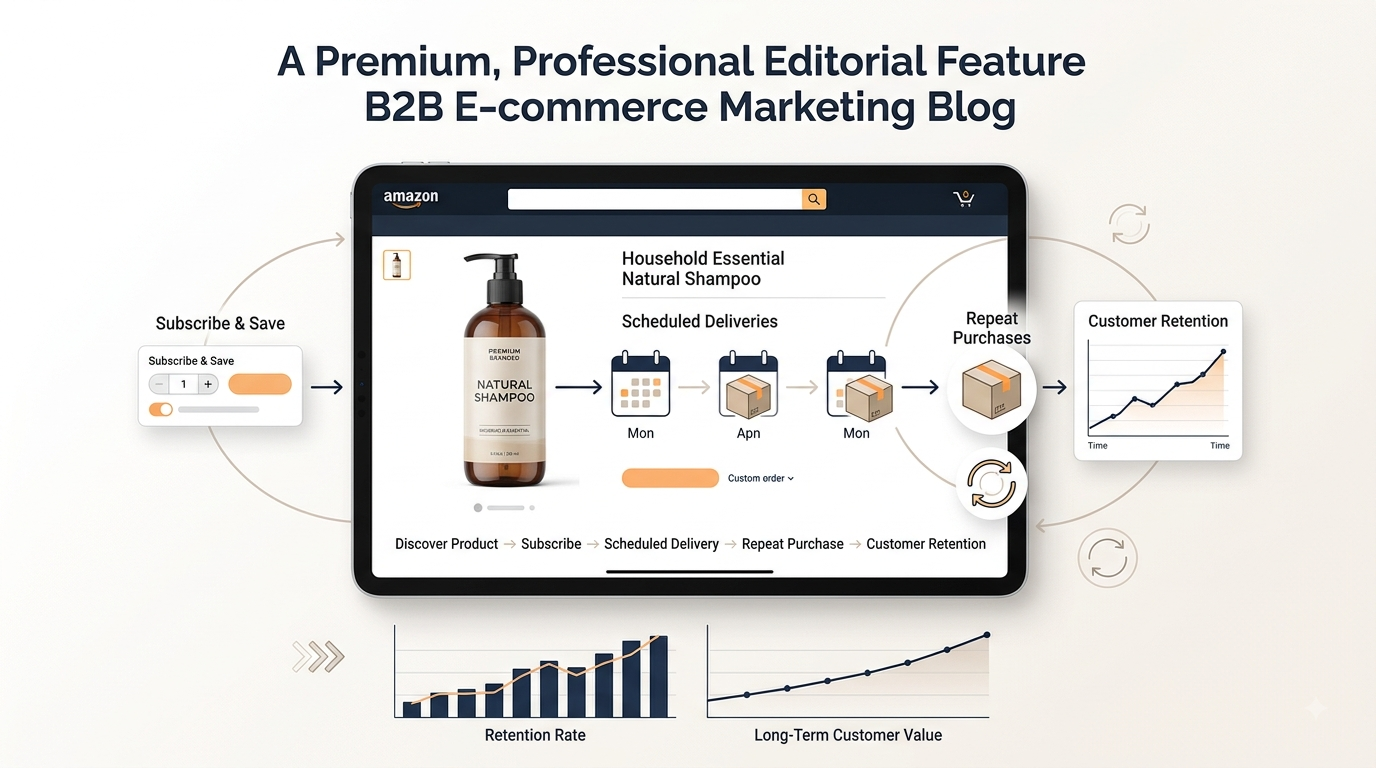
Amazon Subscribe & Save: How Brands Can Increase Customer Retention
1. Introduction: Why Customer Retention Matters on Amazon
Acquiring a new customer on Amazon can require significant investment in advertising, promotions, and product-page optimization. But getting a customer to purchase once is only part of the challenge. For products that customers regularly use and replace, encouraging repeat purchases can create greater long-term value. This is where Amazon Subscribe & Save can become an important part of a brand's retention strategy.
Amazon Subscribe & Save allows eligible customers to schedule recurring deliveries of qualifying products instead of placing a new order each time they need a replacement. This can make purchasing more convenient while giving brands an opportunity to build more consistent repeat buying behavior.
The model works particularly well for products that customers purchase regularly, such as household essentials, personal care products, pet supplies, groceries, and other replenishable items. Instead of relying entirely on customers to remember when they need to reorder, subscriptions can create a more convenient purchasing routine.
For brands, recurring purchases can contribute to repeat sales, more predictable demand, and stronger long-term customer value. However, Subscribe & Save is not a guarantee of customer retention. Product quality, pricing, availability, customer satisfaction, and the overall buying experience still influence whether customers continue their subscriptions.
In this guide, we'll explore how Amazon Subscribe & Save works, which products can benefit from it, how brands can optimize their listings and offers, and how to use performance data to improve customer retention.
2. What Is Amazon Subscribe & Save?
Amazon Subscribe & Save is a recurring-purchase program that allows customers to schedule regular deliveries of eligible products they expect to purchase repeatedly. Instead of returning to Amazon and placing a new order whenever they run out of a product, customers can select the Subscribe & Save option and choose a delivery frequency that fits their needs.
Depending on the product and available options, customers may be able to select different delivery intervals. The program can also offer savings compared with a one-time purchase, although the specific discount and eligibility can vary by product, seller, and current Amazon program terms.
Subscribe & Save works particularly well for replenishable products and everyday essentials. Common examples include household supplies, personal care products, pet products, grocery items, and other products that customers regularly replace. Eligibility depends on Amazon's requirements, product category, seller status, and other program criteria.
For brands and sellers, participation can create another way to encourage repeat purchasing. Traditional repeat purchasing requires customers to remember when they need a product and manually place another order. Subscribe & Save automates much of that process by allowing customers to schedule future deliveries.
The typical customer journey looks like this:
Discover product → Purchase → Select Subscribe & Save → Choose frequency → Receive recurring deliveries
The convenience benefits both sides. Customers can simplify replenishment, while brands can potentially develop more consistent repeat-purchase behavior among customers who genuinely need their products on a recurring basis.
3. How Amazon Subscribe & Save Benefits Brands
Amazon Subscribe & Save can give brands another way to encourage repeat purchasing, particularly for products that customers regularly consume or replace. Instead of relying on customers to remember when they need to reorder, subscriptions can make the replenishment process more convenient and predictable.
One potential benefit is higher purchase frequency. When customers choose recurring deliveries, they can receive products at regular intervals without manually placing each order. This can support repeat purchasing when the product naturally fits a recurring need.
Subscribe & Save may also contribute to customer retention by reducing the effort required to reorder. A convenient purchasing experience can make it easier for satisfied customers to continue buying the same product rather than searching for alternatives.
Recurring orders can also provide brands with greater visibility into future demand. While subscription volumes can change over time, recurring purchasing patterns may help brands understand expected order activity and plan inventory more effectively.
Another potential benefit is higher customer lifetime value. When an acquired customer continues purchasing a product over multiple cycles, the brand has more opportunities to generate value from the original customer relationship.
Convenience can also strengthen the overall customer relationship. When a product consistently meets customer expectations and arrives when needed, customers may have fewer reasons to switch.
However, brands should not assume that Subscribe & Save automatically increases retention or revenue. Results depend on factors such as product type, pricing, product quality, availability, customer satisfaction, subscription adoption, and cancellation behavior. Brands should monitor subscription performance and customer behavior to determine whether the program is delivering meaningful business value.
4. Which Products Are Best Suited for Subscribe & Save?
Amazon Subscribe & Save works best for products that customers naturally use up and need to purchase again. When a product has a predictable consumption cycle, recurring deliveries can make the purchasing process easier for customers and create opportunities for brands to encourage repeat orders.
Household essentials are a common example. Products such as paper goods, cleaning supplies, laundry products, and other consumables can fit naturally into a recurring purchase routine. Personal care products, pet supplies, food and beverages, and certain health and wellness products may also be suitable when customers regularly replenish them.
The product's usage pattern is an important consideration. Products with frequent usage, predictable consumption, and relatively consistent replenishment cycles are generally better candidates. A customer who finishes a household or personal care product every few weeks has a clearer reason to schedule another delivery than someone purchasing an occasional-use item.
Brands should also consider whether repeat purchasing feels convenient rather than unnecessary. The product should provide enough ongoing value for customers to want the same item again.
On the other hand, durable goods that customers typically purchase only once every few years may be less suitable for a recurring subscription model. Furniture, major appliances, certain electronics, and other long-lasting products may not have a natural replenishment cycle.
Ultimately, the strongest Subscribe & Save opportunities come from products where recurring purchasing matches actual customer behavior. Brands should evaluate purchase frequency, consumption patterns, product lifespan, and customer demand before deciding whether subscriptions make sense for a particular product.
5. How Subscribe & Save Can Improve Customer Retention
Customer retention on Amazon often depends on what happens after the first purchase. A customer may like a product but still switch to another brand when it is time to reorder. The effort required to remember the purchase, search for alternatives, compare products, and place another order can create opportunities for competitors to win that customer.
Without Subscribe & Save, the process may look like this:
Customer buys → Product runs out → Customer has to remember → Searches again → May choose competitor
With Subscribe & Save, the process can become:
Customer buys → Subscribes → Automatic delivery → Continued product usage → Repeat purchase
The main advantage is convenience. Once a customer selects a suitable delivery schedule, they do not need to repeat the entire product discovery and purchasing process every time they need the product. This can reduce friction and make replenishment part of their regular routine.
Over time, recurring deliveries may also support habit formation. When a customer consistently receives a product they use and trust, continuing with the same product can become easier than researching alternatives each time. This is particularly relevant for everyday consumables where customers may have little reason to reconsider their choice after finding a product that meets their expectations.
Subscribe & Save can also reduce the need for repeated product research. Customers do not necessarily need to compare prices, reviews, features, and alternatives for every replenishment cycle when they are satisfied with their existing product.
However, convenience alone cannot guarantee retention. Customers can still cancel subscriptions, change delivery schedules, switch products, or choose competitors. Product quality, pricing, availability, customer satisfaction, and the overall experience remain important.
For brands, the goal is therefore not simply to acquire subscribers. It is to provide enough ongoing value that customers have a reason to continue the relationship.
6. Optimize Your Product Listing to Drive Subscriptions
Amazon Subscribe & Save does not replace product listing optimization. Customers still need to understand the product, its value, and why it makes sense for their needs before they consider purchasing it on a recurring basis. A clear and informative listing can help create the confidence needed to choose a subscription.
The product title should clearly communicate what the product is and include important information such as the product type, size, quantity, or relevant variant. Customers should be able to understand the basic offering without having to search through the listing.
Product images should provide practical information about the product. Show its size, quantity, packaging, appearance, usage, and important benefits where appropriate. Clear visuals can help customers understand what they will receive with each recurring delivery.
Bullet points should focus on customer benefits while explaining useful details such as product usage, quantity, durability, or replenishment value. For consumable products, explaining how the product fits into a customer's regular routine can help shoppers understand why recurring delivery may be convenient.
A+ Content can provide additional space for product education and storytelling. Brands can explain why the product is useful for regular consumption, highlight product quality, demonstrate benefits, and help customers understand different sizes or variants.
The goal is to make the product's value clear before asking customers to commit to recurring purchases. When shoppers understand what they are buying, how often they may need it, and how it fits into their routine, they can make a more informed decision about whether Subscribe & Save is appropriate for them.
7. Use Pricing and Promotions Strategically
Price can influence whether customers choose a recurring purchase option, but brands should avoid relying on discounts alone to drive Amazon Subscribe & Save adoption. A strong offer should communicate both financial value and the convenience of receiving products regularly.
Subscribe & Save discounts can give customers an additional reason to choose recurring deliveries, while promotional offers can help introduce shoppers to the subscription model. However, the exact savings available can vary based on Amazon's program rules, product eligibility, and the brand's offer structure.
Competitive pricing also matters. Customers can compare similar products quickly on Amazon, so brands should regularly evaluate how their subscription offer compares with competing products. Pack sizes and product bundles can provide another way to strengthen value perception. For example, a larger pack may offer better value for customers who use the product frequently, while smaller packs may suit customers with lower consumption.
The goal should not simply be to reduce the product's price. Instead of communicating only a discount, brands can emphasize the combined value of savings and convenience:
"Save more when you purchase repeatedly."
This approach positions the subscription as a practical purchasing option rather than a temporary price reduction.
At the same time, brands need to protect healthy margins. A subscription strategy that increases order volume but significantly reduces profitability may not create sustainable value. Businesses should consider product costs, fulfillment expenses, promotional spending, and the economics of recurring orders when evaluating their offers.
Regularly monitoring competitor pricing, promotions, pack sizes, and subscription incentives can also help brands determine whether their Subscribe & Save proposition remains attractive in the market.
8. Improve the Customer Experience to Reduce Subscription Churn
Getting a customer to subscribe is only the beginning of the retention process. A subscription can continue only when the customer feels that the product provides consistent value and the recurring delivery experience works as expected. If those expectations are not met, customers may cancel their subscriptions or switch to another brand.
Product quality problems are one potential cause of churn. If a customer receives a product that does not perform as expected, they may not want another delivery. Late deliveries, damaged packaging, or incorrect product information can create similar problems. Price increases may also affect subscription decisions, particularly when customers can find comparable products at a lower price.
The delivery schedule matters as well. If customers receive too much product too frequently, they may accumulate unused inventory and decide that the subscription no longer fits their needs. Brands should therefore make sure product sizes and typical usage patterns align with customer expectations.
Brands can reduce these risks by maintaining consistent product quality and providing accurate information throughout the listing. Clear descriptions of size, quantity, ingredients, specifications, and intended use can help customers choose an appropriate product.
Customer feedback can provide valuable retention insights. Brands should monitor reviews, customer complaints, cancellation patterns, and other available feedback to identify recurring problems. If customers frequently cancel because they receive too much product, for example, the brand may need to reconsider its pack sizes or communicate usage information more clearly.
Pricing should also remain competitive as market conditions change.
Ultimately, Amazon Subscribe & Save retention depends on delivering value consistently. Getting customers to subscribe is not enough; brands need to give them a reason to continue.
9. Use Customer and Sales Data to Optimize Subscribe & Save
Amazon Subscribe & Save performance should be evaluated using customer and sales data rather than enrollment numbers alone. A product may attract many subscribers but still produce limited long-term value if customers frequently cancel or do not continue purchasing.
Brands should monitor metrics such as subscription enrollment, repeat purchase behavior, subscription revenue, cancellation and churn rates, order frequency, average order value, customer lifetime value, and product-level performance. Together, these metrics can provide a clearer view of how subscriptions contribute to the broader business.
Product-level analysis can help identify which products naturally attract subscribers. Consumables with predictable usage patterns may generate stronger subscription adoption than products with irregular purchasing cycles. Brands can use this information to determine where additional Subscribe & Save optimization may have the greatest potential.
Cancellation data can reveal another important part of the customer journey. If a particular product experiences higher churn, brands can investigate potential causes such as pricing, product quality, delivery frequency, pack size, or customer expectations.
Order frequency can also provide useful insights. Brands can examine whether customers tend to select shorter or longer replenishment intervals and whether certain schedules result in stronger retention.
By analyzing these patterns, businesses can identify where customers drop off and where improvements may be needed. Data can also help brands evaluate which products, offers, and customer segments deserve greater attention.
The objective is to move beyond simply asking how many customers subscribed. A more useful question is whether those subscriptions create sustainable repeat purchasing and long-term customer value.
10. Common Amazon Subscribe & Save Mistakes
Amazon Subscribe & Save can support repeat purchasing, but brands can reduce its effectiveness by treating subscriptions as a simple discount or acquisition tactic. One common mistake is offering subscriptions on products that customers do not naturally purchase on a recurring basis. Durable products or items with unpredictable replacement cycles may not provide a strong reason for regular deliveries.
Focusing only on discounts can also create problems. While savings may encourage initial subscription adoption, customers are more likely to continue when the product consistently provides value. Poor product quality, inaccurate product information, or unmet expectations can lead to cancellations regardless of the discount.
Pack size and delivery frequency also deserve careful consideration. If customers receive more product than they need, they may accumulate unused inventory and cancel their subscriptions. Clear product information can help customers select an option that matches their consumption habits.
Brands should also monitor cancellation patterns and customer reviews. Recurring complaints about quality, packaging, pricing, or delivery can reveal problems that affect subscription retention.
Another mistake is increasing prices without considering how subscribers may respond. Significant price changes can affect perceived value and encourage customers to reconsider their subscriptions.
Most importantly, subscription acquisition should not be treated as the final goal. The objective is to build sustainable repeat purchasing. Brands should focus on product quality, customer satisfaction, competitive value, and a reliable purchasing experience to encourage customers to continue their subscriptions.
11. A Practical Amazon Subscribe & Save Retention Strategy
A successful Amazon Subscribe & Save strategy should connect product selection, listing optimization, customer experience, and performance analysis. Brands can use the following framework to build a more sustainable approach to recurring purchases.
Step 1: Identify replenishable products. Start by finding products with predictable usage and repeat demand. Focus on items customers naturally need to replace or purchase regularly.
Step 2: Optimize the product page. Improve product titles, images, bullet points, A+ Content, and product information so customers clearly understand what they are buying and why it fits their needs.
Step 3: Make the subscription value clear. Communicate the benefits of recurring delivery, including convenience and any applicable savings. The goal is to make the subscription feel useful rather than simply discounted.
Step 4: Monitor subscription performance. Track enrollment, repeat orders, subscription revenue, cancellations, and other relevant metrics to understand how customers respond.
Step 5: Analyze customer feedback. Review customer reviews, complaints, and cancellation patterns to identify why customers continue or leave.
Step 6: Optimize pricing and frequency. Evaluate pack sizes, pricing, promotions, and delivery schedules to determine what works best for different products and customer needs.
Step 7: Continuously improve. Use performance data and customer insights to refine product listings, offers, and the overall subscription experience. Regular optimization can help brands respond to changing customer behavior and improve the long-term value of Amazon Subscribe & Save.
12. The Future of Customer Retention on Amazon
Amazon's ecosystem is becoming increasingly data-driven, giving brands more opportunities to understand how customers discover, purchase, and continue using products. As personalization and AI-powered product discovery develop, shoppers may receive more relevant recommendations based on their interests, purchasing behavior, and product needs.
Customer insights are also becoming increasingly important. Brands can use available performance and behavioral data to understand purchasing patterns, identify opportunities for repeat purchases, and recognize potential reasons for customer churn. This makes customer lifetime value an increasingly important metric alongside individual order revenue.
The connection between advertising, product listings, analytics, and retention is also likely to become more important. Instead of managing each part of the Amazon strategy independently, brands can use insights across the customer journey to create a more consistent experience.
For brands, this means thinking beyond winning the first purchase. Acquiring a customer is only the beginning of the relationship. The larger opportunity lies in delivering a product and experience that gives customers a reason to return.
Amazon Subscribe & Save can support that strategy for suitable products, but long-term retention will ultimately depend on consistent product value, customer satisfaction, convenience, and a strong overall shopping experience.
13. Conclusion: Turn One-Time Buyers Into Repeat Customers
Amazon Subscribe & Save can give brands a convenient way to encourage repeat purchasing, particularly when products have predictable replenishment cycles. However, successful subscription strategies require more than simply making a product available for recurring delivery.
Choosing the right products is the starting point. Strong product listings can help customers understand the product and recognize its value, while competitive pricing and applicable savings can make recurring purchases more appealing. However, customer retention ultimately depends on delivering consistent product quality, reliable service, and a positive overall experience.
Data should guide the process. By monitoring subscription enrollment, repeat purchases, cancellations, customer feedback, and product performance, brands can identify opportunities to improve their retention strategy over time.
For brands looking to build stronger long-term growth on Amazon, PDMG can help evaluate sales and customer data, optimize product listings, improve advertising performance, and develop strategies focused on customer retention and sustainable Amazon growth.

