Amazon Premium A+ Content: Best Practices for Higher Conversions
1. Introduction: Why Product Pages Need More Than Basic A+ Content
Competition on Amazon continues to make product differentiation more difficult. Shoppers often compare several products before making a purchase, and similar products can have similar features, prices, and ratings. A basic product page may provide the necessary information, but brands often need a stronger experience to communicate why their product deserves attention.
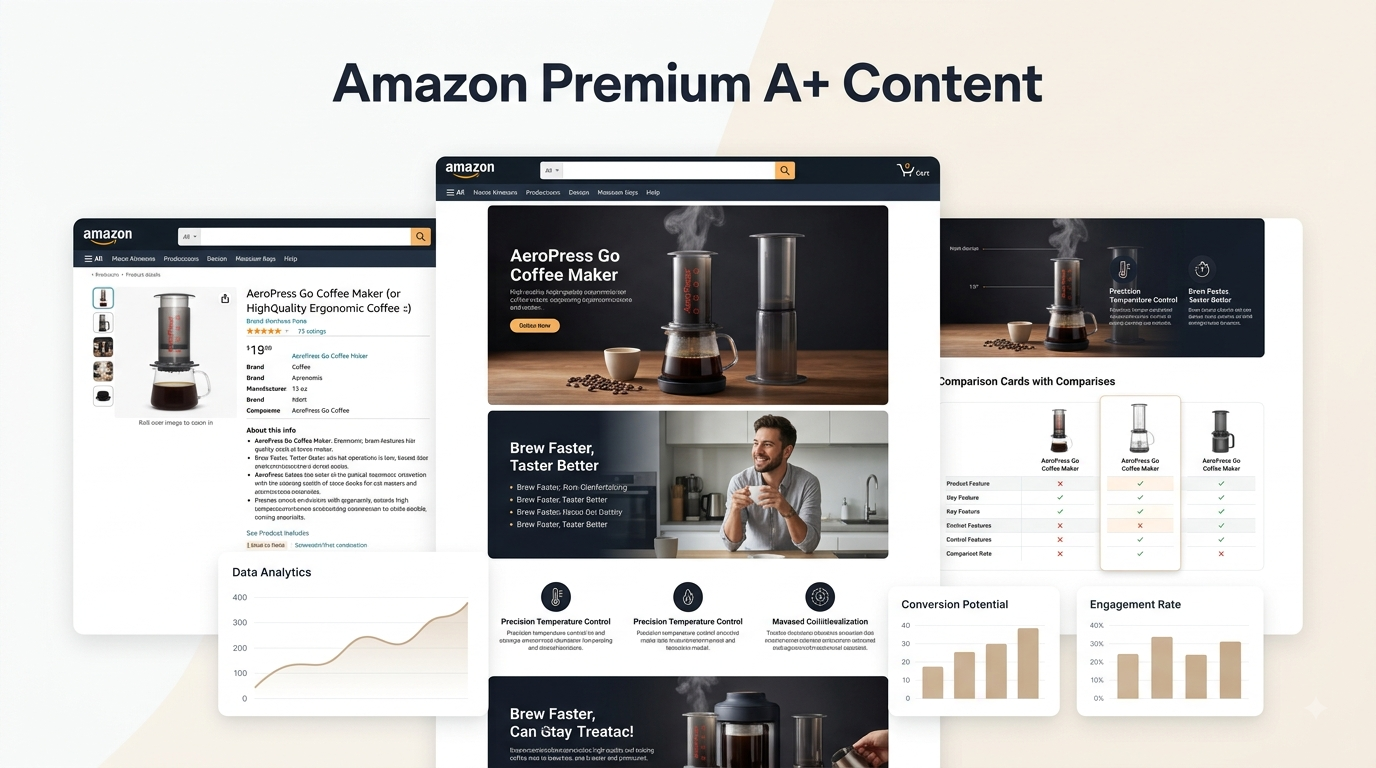
Amazon Premium A+ Content gives eligible brands more advanced tools to enhance their product detail pages. Compared with standard Amazon A+ Content, Premium A+ Content can provide richer visual experiences, interactive elements, comparison modules, and additional opportunities to explain product benefits. These elements can help brands communicate value more effectively and guide shoppers through the buying decision.
Strong visuals can demonstrate how a product works, while comparison modules can help shoppers understand differences between products in a brand's portfolio. Storytelling can also connect product features with specific customer needs and use cases.
A better product-page experience does not guarantee higher conversions, but clear information, compelling visuals, and effective product education can reduce uncertainty and help shoppers make more informed decisions. This makes Premium A+ Content an important consideration for brands focused on Amazon product page optimization and conversion rate improvement.
In this guide, we'll explore practical Amazon A+ Content best practices, including content structure, visual design, product storytelling, comparisons, mobile optimization, and conversion-focused strategies.
2. What Is Amazon Premium A+ Content?
Amazon Premium A+ Content is an advanced version of Amazon A+ Content that gives eligible brands more ways to enhance their product detail pages. Instead of relying primarily on standard text and image modules, brands can use richer layouts and interactive-style experiences to present product information in a more engaging format.
Standard Amazon A+ Content already allows brands to improve product pages with enhanced images, branded layouts, product descriptions, and other visual modules. Premium A+ Content expands these possibilities with more sophisticated design options, larger visual areas, comparison experiences, navigation elements, and other modules that can help shoppers understand a product more quickly.
The content can support different stages of the customer's decision-making process. For example, visual storytelling can introduce a product's main benefits, comparison modules can help shoppers evaluate related products, and detailed sections can explain features, use cases, and product differences.
Premium A+ Content also fits into a broader Amazon brand strategy. Brands can use it alongside their Amazon Brand Store, product listings, advertising campaigns, and other forms of product-page content to create a more consistent shopping experience.
Eligibility is an important consideration. Amazon determines access based on factors such as brand enrollment and account or ASIN eligibility, so not every seller or product can automatically use every Premium A+ Content feature.
Most importantly, brands should not view Premium A+ Content simply as a more attractive product description. It should function as a conversion-focused product experience that helps shoppers understand the product, answer purchasing questions, reduce uncertainty, and move closer to a buying decision.
3. Premium A+ Content vs. Standard A+ Content
Both Standard A+ Content and Amazon Premium A+ Content help brands improve the presentation of their product detail pages. However, Premium A+ Content provides more advanced options for visual communication, product education, and brand storytelling. The main difference is not simply how attractive the page looks, but how much space and flexibility brands have to guide shoppers through the buying decision.
| Feature | Standard A+ | Premium A+ |
|---|---|---|
| Enhanced visuals | ✓ | ✓ |
| Advanced modules | Limited | More extensive |
| Product storytelling | ✓ | ✓ |
| Interactive experiences | Limited | More advanced |
| Comparison functionality | Available in selected formats | More extensive options |
| Space for communicating benefits | Moderate | Greater |
| Customer education | Good | More comprehensive |
| Brand differentiation | Moderate | Strong |
Visual capabilities represent one of the clearest differences. Premium A+ can give brands more opportunities to use large images, richer layouts, and visual sections to demonstrate product features and benefits.
Advanced modules can also create more engaging product experiences. Depending on eligibility and available Amazon modules, brands can use richer comparison sections, navigation elements, visual callouts, and other formats to organize information more effectively.
Product storytelling also becomes easier to develop. Brands can move beyond simply listing features and create a structured journey that explains the product, demonstrates its benefits, addresses customer questions, and shows relevant use cases.
For customer education, this additional space can help brands explain complex products or highlight differences between products in the same portfolio. Strong Amazon A+ Content best practices focus on making this information easy to understand rather than simply adding more visual elements.
However, Premium A+ Content does not automatically guarantee higher sales or conversions. Its effectiveness depends on the quality of the content, product-market fit, pricing, reviews, traffic, and the overall customer experience. Brands should use Premium A+ as a strategic tool for Amazon product page optimization, not as a guaranteed sales solution.
4. How Premium A+ Content Can Influence Conversions
Strong Amazon Premium A+ Content can help improve the shopping experience by giving customers the information they need to make a confident purchase decision. On Amazon, shoppers cannot physically touch or test a product before buying it. This creates uncertainty, especially for products with complex features, technical specifications, or multiple alternatives. Well-structured A+ Content can address these concerns before they become reasons to leave the product page.
One important role of Premium A+ Content is to explain product benefits visually. Instead of asking shoppers to interpret a list of technical features, brands can use images, diagrams, comparisons, and structured sections to show how those features solve real customer problems.
For example, instead of simply stating "Durable stainless-steel construction," a brand could create a visual sequence:
Material → Durability → Everyday Use → Customer Benefit
This approach connects a product characteristic with a practical outcome and makes the value easier to understand.
Premium A+ Content can also answer common customer questions about size, compatibility, usage, maintenance, performance, or product differences. Addressing these questions directly can reduce uncertainty and help shoppers evaluate the product without searching elsewhere.
Trust also plays an important role. Consistent branding, clear product information, demonstrations, and authentic use cases can create a more professional shopping experience. Comparison modules can further help customers understand how products differ and identify which option fits their needs.
However, the goal should not be to overwhelm shoppers with visuals. Effective Amazon A+ Content best practices focus on clarity, relevance, and useful information. When brands combine strong storytelling with clear benefits and customer education, Premium A+ Content can create a stronger product-page experience and support the conversion process.
4. How Premium A+ Content Can Influence Conversions
Premium A+ Content can support conversions by helping shoppers understand a product and feel more confident about their purchase decision. On Amazon, customers often compare several products before buying. If a product page leaves important questions unanswered, shoppers may move to another listing. A well-structured A+ experience can address those concerns and make the buying process easier.
One of the main benefits of strong A+ content is reducing purchase uncertainty. Detailed visuals, product demonstrations, comparison sections, and clear explanations can help customers understand what they are buying before they make a decision. This becomes especially useful for products with technical features, multiple use cases, or unfamiliar specifications.
Visual communication can also make product benefits easier to understand. Instead of simply stating, "Durable stainless-steel construction," a brand could create a visual sequence that explains:
Material → Durability → Everyday use → Customer benefit
This approach connects a technical feature with a practical outcome. It helps shoppers understand why the feature matters rather than asking them to interpret the specification themselves.
Premium A+ Content can also answer common customer questions, highlight important differentiators, and explain how a product compares with alternatives. These elements can build trust by providing useful information before purchase.
A strong brand experience can further reinforce customer confidence. Consistent visuals, clear messaging, and thoughtful storytelling can help shoppers recognize the brand and understand its value proposition.
However, A+ Content works alongside other factors such as pricing, reviews, product quality, availability, and advertising. It cannot compensate for weaknesses in the overall offer. Its role is to provide a clearer and more persuasive product experience that helps qualified shoppers make an informed decision.
5. Best Practice #1: Lead With Benefits, Not Features
One of the most important Amazon A+ Content best practices is to focus on customer benefits instead of simply listing product features. Features describe what a product has or how it works. Benefits explain why those features matter to the customer.
For example, a basic product statement might say:
"32-ounce insulated stainless-steel bottle."
This tells shoppers what the product is, but it does not explain why they should choose it. A more customer-focused message could say:
"Keeps your drink cold for hours, making it ideal for long commutes, workouts, and travel."
The second version connects the product feature with a practical outcome. It gives shoppers a reason to care about the specification.
Brands should begin by identifying the customer problem or need. Then, explain how the product addresses that need. Finally, connect the relevant features to real-world outcomes that shoppers can understand.
For example, instead of presenting insulation as a technical specification, explain how it helps maintain drink temperature throughout a workout or commute. Instead of simply describing a lightweight design, explain how it makes the product easier to carry during travel.
Customer-focused language also makes A+ Content easier to scan and understand. Each section should answer a simple question: "How does this product make the customer's life better?"
This approach can make Premium A+ Content more useful because it shifts the focus from what the product contains to what the customer can accomplish with it.
6. Best Practice #2: Build a Strong Visual Story
Premium A+ Content should guide shoppers through a clear and logical story rather than present a collection of unrelated images and text. Every section should have a purpose and help customers move from understanding the problem to feeling confident about the product.
A useful structure is:
Problem → Solution → Key Benefits → Features → Proof → Brand → Purchase Confidence
Start by introducing the customer's need or problem. Then show how the product provides a solution. Follow this with the most important benefits and supporting features. Later sections can provide proof, demonstrate real-world use, and introduce the brand's value.
Strong visual consistency also matters. Use a consistent visual identity across images, typography, layouts, colors, and messaging. High-quality product photography can show important details, while lifestyle images can demonstrate how the product fits into everyday situations.
Infographics can simplify technical information and help shoppers understand specifications quickly. Close-up images can highlight materials, construction, controls, or other important details. Before-and-after visuals can also work well when the product creates a visible change or solves a specific problem.
The written messaging should support the visuals rather than repeat them. Each section should add useful information and move the shopper forward.
Most importantly, do not fill every available module simply because Amazon provides the space. Too much content can make a product page difficult to navigate and can distract from the most important selling points. Effective Premium A+ Content uses the available space strategically, giving shoppers the right information at the right stage of their decision-making process.
7. Best Practice #3: Use Premium Modules Strategically
Premium A+ Content provides brands with more opportunities to present product information, but more modules do not automatically create a better product page. Brands should select each module based on a specific objective and the type of information shoppers need before making a purchase.
A hero section can introduce the product and communicate its primary value proposition. Feature-focused modules can explain important product capabilities and connect them to customer benefits. Demonstration sections can show how the product works, while lifestyle content can help shoppers visualize how it fits into their daily lives.
Comparison modules can help customers evaluate related products within a brand's portfolio. Technical sections can explain specifications, materials, dimensions, compatibility, or other details that may influence the buying decision. A brand story can introduce the company and communicate its values when that information supports customer confidence.
Brands can also use educational sections to address frequently asked questions and clarify potential concerns. This can be especially useful for products that require more explanation before purchase.
The most effective approach is to assign a clear purpose to every section. Before adding a module, ask what question it answers or what customer objection it addresses. If a section does not provide useful information, demonstrate a meaningful benefit, or strengthen purchase confidence, it may not need to be included.
The rule is simple: every section should have a job. Premium A+ Content should create a structured product experience, not simply fill available space with additional content.
8. Best Practice #4: Design for Mobile Shoppers
Mobile optimization should be a core part of any Amazon A+ Content strategy. Many shoppers browse Amazon from smartphones, where smaller screens can make dense layouts, long paragraphs, and text-heavy graphics difficult to understand. Premium A+ Content should therefore remain clear and useful even when shoppers view it on a smaller screen.
Use readable text and a clear visual hierarchy so shoppers can quickly identify the most important information. Keep messaging concise and focus each section on one main idea. Short headlines, supporting copy, and strong visuals can make the content easier to scan.
Images should also remain clear on smaller screens. Use high-quality visuals with strong contrast and avoid placing important information in tiny text inside graphics. If shoppers need to zoom in to understand a key benefit or specification, the design may not be working effectively.
Brands should review how each image and module appears across different screen sizes before publishing. Check whether headlines remain readable, product details remain visible, and important information stays easy to find.
Do not rely entirely on image text to communicate essential product information. Important benefits, specifications, and customer-facing messages should remain accessible through the page's content as well.
A mobile-first approach helps ensure that Premium A+ Content delivers a consistent experience regardless of how customers access the product page.
9. Best Practice #5: Address Customer Objections
Strong Amazon A+ Content should answer the questions that may prevent a shopper from completing a purchase. Customers often have concerns about fit, compatibility, durability, included accessories, product differences, or ease of use. If a product page does not address these concerns, shoppers may leave the listing to search for answers or consider another product.
Brands can identify common objections by analyzing customer reviews, Amazon Q&A, return reasons, customer service interactions, and recurring feedback. These sources can reveal the questions shoppers repeatedly ask before or after purchasing a product.
For example, customers may want to know:
- Will this fit?
- Is it compatible with X?
- How durable is it?
- What's included?
- How does this compare with the previous model?
- Is it suitable for beginners?
Premium A+ Content can address these questions proactively through dedicated visual sections, comparison modules, product demonstrations, diagrams, and clear explanations. For a compatibility concern, a brand could show compatible models in a simple visual chart. For durability concerns, it could highlight construction, materials, testing, or appropriate use cases. A comparison section could explain the differences between two models and help shoppers select the right option.
This approach makes the product page more informative while reducing the amount of uncertainty shoppers may have before purchasing. It also shows that the brand understands common customer concerns.
The goal is not to fill the page with every possible question. Instead, identify the objections that matter most to the buying decision and use Premium A+ Content to answer them clearly before the shopper has to ask.
10. Best Practice #6: Use Comparison Modules to Support Product Selection
Comparison modules can help shoppers understand the differences between products and choose the option that best matches their needs. When a brand offers several models, sizes, or variations, customers may struggle to determine which product is right for them. A clear comparison can make that decision easier.
Brands can use comparison sections to differentiate product variants based on factors such as intended use, size, capacity, features, compatibility, or experience level. For example, one model may suit beginners who want simple setup, while another may target experienced users who need more advanced features.
Comparison modules can also introduce complementary products from the same brand. A shopper viewing one product may discover related items that support the same use case or solve an additional customer need. This can increase awareness of the broader product portfolio and help customers explore relevant options.
The information should remain simple and easy to scan. Focus on meaningful differences rather than listing every specification available. Shoppers should be able to understand the main distinctions quickly and identify which product best fits their requirements.
Comparisons must also remain accurate and genuinely useful. Brands should avoid misleading claims or presenting competitors unfairly. A strong comparison module helps customers make a more informed choice while reinforcing the brand's credibility.
The goal is not simply to showcase more products. It is to remove confusion and help shoppers select the right product with greater confidence.
11. Best Practice #7: Combine A+ Content With Amazon SEO
Premium A+ Content should work as part of the broader Amazon product page rather than as a standalone marketing asset. A strong listing should maintain a consistent message across the product title, bullet points, product description, images, A+ Content, and other relevant elements.
The product title should clearly identify the product and communicate important attributes. Bullet points can highlight key features and customer benefits, while product images can demonstrate the product in use. Premium A+ Content can then expand on these messages with deeper product education, visual storytelling, comparisons, and use cases.
Reviews can provide additional insight into customer expectations and common questions. Brands can use this feedback to identify topics that deserve more explanation within their A+ Content. PPC can also work alongside organic optimization by bringing relevant shoppers to product pages and providing search-term and campaign performance insights.
The Brand Store can extend the experience beyond an individual product by helping customers explore related products and understand the broader brand offering.
However, brands should not treat A+ Content as another place to insert keywords repeatedly. Amazon A+ Content is primarily designed to support product education, differentiation, and conversion. Keyword optimization remains important across the overall listing, but A+ Content should focus on helping shoppers understand the product and make a confident purchasing decision.
When these elements work together, brands can create a more consistent product experience that supports both Amazon SEO and conversion-focused product page optimization.
12. Common Premium A+ Content Mistakes to Avoid
Even strong Premium A+ Content can lose its effectiveness when brands focus too much on appearance and not enough on the customer experience. One common mistake is using too much text. Shoppers should be able to understand the main message quickly without reading large blocks of copy.
Feature dumping can create a similar problem. Listing specifications without explaining their customer value makes the content harder to understand. Poor-quality images, inconsistent branding, and excessive decorative graphics can also make a product page look less professional.
Brands should avoid repeating the same information across multiple sections. Each module should introduce a useful point, explain a benefit, answer a question, or provide meaningful product education. Ignoring mobile shoppers can also reduce the impact of otherwise strong content.
Unsupported claims create another risk. Product benefits and performance statements should remain accurate and supported by appropriate evidence. Brands should also avoid creating A+ Content without understanding competitors and the alternatives customers are considering.
Another mistake is failing to address customer objections. Reviews, Q&A, returns, and customer feedback can reveal concerns that the product page should answer.
Finally, brands should not treat Premium A+ Content as a one-time project. Customer expectations, competitors, products, and marketplace trends change over time. Regularly reviewing performance and updating content can help keep the product experience relevant and useful.
13. How to Measure Whether Premium A+ Is Working
Brands should measure the performance of Premium A+ Content instead of assuming that a more visually engaging product page will automatically produce better results. The first step is to establish a baseline before making major content changes. Record relevant performance metrics so you can compare results after implementing or updating the content.
Useful metrics can include conversion rate, unit session percentage, sales, revenue per visitor or session, product-page traffic, and engagement metrics where Amazon provides them. Customer feedback and product returns can also provide valuable insight. For example, recurring customer questions or return reasons may reveal areas where the product page needs clearer information.
Comparing performance before and after implementation can help brands understand whether the updated content contributes to stronger results. However, brands should consider other factors that may affect performance, including pricing, advertising, promotions, reviews, seasonality, and changes in traffic.
Continuous testing can further improve Amazon product page optimization. Brands can experiment with different headlines, product visuals, benefit statements, comparison sections, and module structures to determine which approaches communicate value most effectively.
The goal is not simply to create Premium A+ Content once and leave it unchanged. Brands should treat the product page as an ongoing optimization opportunity. By combining performance data with customer feedback, they can identify what works, address weaknesses, and continuously improve the shopping experience.
14. Premium A+ Content Optimization Checklist
Before publishing or updating Premium A+ Content, brands should review the entire product experience to make sure every section supports the customer's buying decision.
- Clear value proposition
- Strong hero visual
- Benefits clearly explained
- Product features demonstrated
- Customer objections addressed
- Comparison content included where useful
- Mobile experience reviewed
- Brand identity consistent
- Claims verified
- Content aligned with the rest of the listing
- Conversion metrics established
- Content reviewed periodically
This checklist can help brands identify gaps before publishing. The strongest Premium A+ Content combines clear messaging, useful product information, high-quality visuals, and consistent branding. It should also work alongside the product title, bullet points, images, reviews, advertising, and Brand Store.
After publishing, brands should continue reviewing performance and customer feedback. Regular updates can help keep the content relevant as products, customer expectations, competitors, and marketplace conditions change.
15. Conclusion: Premium A+ Should Sell the Experience, Not Just the Product
Premium A+ Content is not about adding more content to a product page. It is about making the buying decision easier for shoppers. Every visual, message, and module should help customers understand the product, recognize its value, and feel more confident about purchasing it.
Brands should use visuals strategically, focus on customer benefits, address common objections, and create a clear product story. Comparison sections can help shoppers choose the right option, while consistent messaging across the listing can create a stronger and more professional brand experience.
Performance should also guide future improvements. By tracking conversion metrics, reviewing customer feedback, and testing different content approaches, brands can continuously improve their product pages.
For brands looking to get more value from their Amazon traffic, professional Amazon listing optimization and A+ Content strategy can help turn product-page visits into stronger conversion opportunities. PDMG helps brands evaluate their listings, improve product-page content, and develop Amazon strategies designed around customer needs and performance.