Amazon China Tariffs 2026: How FBA Sellers Must Rebuild Their Sourcing Strategy
Amazon China Tariffs 2026 are hitting sellers at the worst possible time—right when competition is rising and margins are already under pressure. For years, many Amazon FBA businesses relied heavily on China as their primary sourcing hub due to its cost efficiency and manufacturing scale. But that advantage is now being challenged.
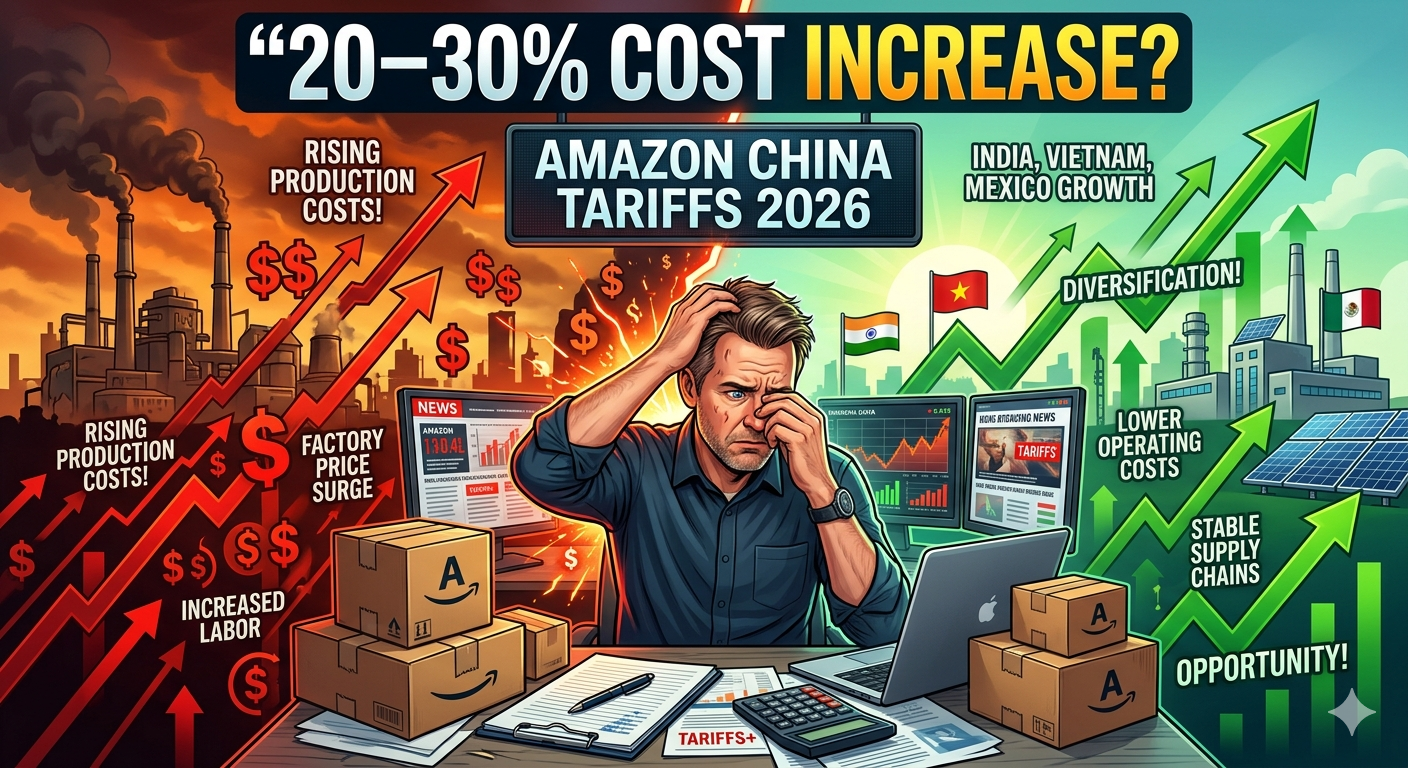
With the introduction of Amazon China Tariffs 2026, sellers are seeing cost increases of 20–30% across key product categories. On top of that, the removal of the de minimis rule for certain imports is eliminating a critical cost-saving loophole that many small and mid-sized sellers depended on. What once felt like a predictable and optimized supply chain is now becoming expensive, uncertain, and difficult to manage.
The real impact? Shrinking profit margins, tighter cash flow, and reduced flexibility in pricing. Sellers who ignore these changes risk slowly losing their competitive edge, while those who adapt early have an opportunity to come out stronger.
In this guide, we’ll break down exactly what Amazon China Tariffs 2026 mean for your business—and more importantly, how you can rebuild your sourcing strategy to reduce costs, protect margins, and stay profitable in 2026 and beyond.
What Amazon China Tariffs 2026 Mean for Sellers
Amazon China Tariffs 2026 continue to reshape the economics of selling on Amazon, and many sellers are underestimating how deep these changes go. While tariffs on Chinese imports are not new, what has changed in 2026 is the lack of relief. The Section 301 tariffs remain fully active, and there has been no significant rollback or reduction. This means that sellers importing from China are still subject to elevated duties across multiple product categories, keeping costs consistently high.
Section 301 Tariffs Still in Full Effect
For many FBA sellers, Section 301 tariffs have been part of operations for years. However, expectations of policy easing have not materialized in 2026. Instead, these tariffs continue to apply broadly, directly increasing the cost of goods imported from China. Therefore, businesses that built their pricing models around pre-tariff assumptions are now facing ongoing pressure on margins.
End of De Minimis Advantage
One of the biggest shifts under Amazon China Tariffs 2026 is the removal or tightening of the de minimis exemption, which previously allowed low-value shipments to enter without significant duties. However, this advantage is now disappearing for China—and in many cases, globally. As a result, even smaller shipments that were once cost-efficient are now subject to taxes and duties, eliminating a key workaround many sellers relied on.
Higher Costs, More Scrutiny
With these changes in place, every shipment is now effectively taxed at a higher rate. In addition, customs inspections are becoming more frequent and stringent. Therefore, sellers are not only dealing with increased landed costs but also potential delays and compliance challenges. This combination makes sourcing from China more complex, expensive, and less predictable than ever before.
How Amazon China Tariffs 2026 Impact FBA Sellers
The real impact of Amazon China Tariffs 2026 becomes clear when you break down the numbers at a product level. What looks like a “20–30% cost increase” on paper quickly turns into a serious margin problem once you factor in shipping, duties, and Amazon fees. For most FBA sellers, profitability is no longer just about selling more—it’s about surviving tighter economics.
Rising Product & Landed Costs
The most immediate effect is the increase in product cost itself. If you were sourcing a product at $5 earlier, it could now effectively cost $6–$6.50 after tariffs. However, the impact doesn’t stop there. Shipping costs, insurance, and import duties are layered on top, increasing your total landed cost significantly. As a result, even small price increases at the manufacturing level are magnified by the time the product reaches Amazon’s warehouse.
Pressure on Margins & FBA Fees
Amazon FBA fees have not decreased to offset these changes—in fact, they continue to rise in many categories. Therefore, sellers are getting squeezed from both sides: higher sourcing costs and stable or increasing fulfillment fees. For example, a product that once had a healthy 30% margin may now be operating at 10–15%, or even lower if pricing cannot be increased due to competition.
Who Gets Hit the Hardest
Not all sellers are affected equally. Low-ticket products suffer the most because they have very little room to absorb cost increases. Beginners entering the market are also at a disadvantage, as they lack the experience and capital to adapt quickly. In addition, highly competitive niches—where price wars are common—make it nearly impossible to pass these increased costs onto customers. As a result, many sellers in these categories are seeing their profits disappear entirely.
Why Ignoring Amazon China Tariffs 2026 is Risky
Many sellers are still in a wait-and-watch mode, hoping that costs will eventually drop or that policy changes will bring relief. However, this assumption is becoming increasingly dangerous. The reality is that current conditions are not temporary fluctuations—they reflect a more permanent shift in global trade dynamics.
Tariffs Are Here to Stay
Despite ongoing discussions around trade policies, there has been no meaningful rollback. Tariffs remain stable, and in many cases, enforcement is becoming stricter. Therefore, building a strategy based on “waiting it out” can lead to continuous margin erosion and missed opportunities to adapt early.
Competitors Are Already Moving
While some sellers hesitate, others are actively restructuring their sourcing strategies, negotiating better supplier terms, and exploring alternative manufacturing regions. As a result, these proactive sellers are gaining a competitive edge—better margins, more pricing flexibility, and stronger long-term positioning.
This is not a short-term problem — it’s a long-term shift. Sellers who fail to recognize this risk falling behind, not just in profitability, but in overall market relevance.
Step 1: Renegotiate with Chinese Suppliers
The first and most immediate step to handle rising costs is to go back to your existing suppliers and renegotiate terms. Many sellers overlook this, assuming prices are fixed—but in reality, suppliers are often open to discussion, especially if you’ve been a consistent buyer.
Ask for Better Pricing & Terms
Start by requesting discounts or revised pricing based on the new tariff environment. Additionally, explore options where the cost burden is shared between you and the supplier. This could mean slight price reductions, bundled shipping deals, or even adjustments in packaging to reduce overall costs. In many cases, suppliers prefer to retain long-term clients rather than lose business, so they are willing to negotiate more than expected.
You should also ask for flexible payment terms. For example, instead of paying 100% upfront, negotiate a 30/70 structure or extended payment timelines. This helps ease cash flow pressure, which is critical when margins are tightening.
Strengthen Your Negotiation Strategy
Approach negotiations with leverage. If you’re ordering in volume, use that as a bargaining tool to secure better pricing. Additionally, don’t rely on a single supplier—compare multiple vendors to understand the best possible rates in the market. For example, getting quotes from 2–3 suppliers gives you a stronger position to negotiate effectively.
By taking a proactive approach, you can reduce some of the cost pressure without immediately overhauling your entire sourcing strategy.
Step 2: Reduce Product & Packaging Costs
Once supplier negotiations are in motion, the next step is to optimize your product and packaging design. Small changes here can create a meaningful reduction in overall costs—especially when tariffs and shipping are calculated based on weight, size, and declared value.
Optimize Size, Weight & Materials
Start by evaluating whether your product can be made lighter or more compact without affecting quality. Lightweight packaging not only reduces shipping costs but also lowers the total declared value, which directly impacts tariff calculations. Similarly, smaller product dimensions can help you save on both freight charges and storage fees within FBA.
Additionally, consider switching to alternative materials that are more cost-efficient. In many cases, slight modifications—like using thinner packaging, recyclable materials, or simplified designs—can significantly cut expenses without compromising customer experience.
Why This Matters
These optimizations work on multiple levels. They reduce tariffs by lowering the import value, and at the same time, they bring down shipping and logistics costs. As a result, even if tariffs remain high, your overall landed cost becomes more manageable—giving you better control over margins without increasing your selling price.
Step 3: Diversify Sourcing Beyond China
As the pressure from Amazon China Tariffs 2026 continues to build, relying entirely on one country for sourcing is no longer a safe strategy. Sellers who want long-term stability must start exploring alternative manufacturing regions. Diversifying your supply chain not only reduces tariff exposure but also gives you flexibility in pricing, logistics, and risk management.
Vietnam: Lower Costs & Growing Manufacturing Hub
Vietnam has quickly emerged as a strong alternative to China for many product categories. Labor costs are generally lower, and the country has been actively expanding its manufacturing capabilities. As a result, many global brands have already shifted part of their production to Vietnam. For FBA sellers, this means access to competitive pricing without the heavy tariff burden associated with China. Additionally, Vietnam’s trade agreements with multiple countries can further reduce import duties.
Mexico: Faster Delivery & Nearshoring Advantage
Mexico offers a completely different advantage—proximity. For sellers targeting the U.S. market, sourcing from Mexico significantly reduces shipping times compared to Asia. This nearshoring approach allows for faster restocking, lower freight costs, and better inventory management. As a result, you can operate with leaner inventory cycles and respond quickly to demand changes. While manufacturing costs may sometimes be higher than in Asia, the savings in logistics and speed often balance it out.
India: Strong in Specialized Categories
India is another promising option, especially for specific categories like textiles, handicrafts, leather goods, and certain industrial products. The country also provides export incentives and government support for manufacturers, which can translate into better pricing for buyers. In many cases, Indian suppliers are more flexible with customization and smaller order quantities, making it attractive for growing brands.
Build a Hybrid Sourcing Strategy
Instead of completely abandoning China, the smarter approach is to adopt a hybrid sourcing model. This means continuing to source certain products from China where it still makes sense, while gradually shifting other products to countries like Vietnam, Mexico, or India. By doing so, you reduce dependency on a single market and protect your business from sudden policy changes or cost spikes.
Step 4: Rethink Logistics & Inventory Strategy
The way you manage logistics and inventory needs to evolve alongside your sourcing strategy. What worked earlier—bulk shipping large quantities at once—is now becoming increasingly risky. With higher tariffs and rising landed costs, committing too much capital into a single shipment can strain cash flow and increase exposure if demand slows down.
From Bulk Shipping to Flexible Shipments
Traditionally, sellers preferred bulk shipping to reduce per-unit freight costs. However, this approach now ties up more money in inventory and increases the impact of tariffs on each shipment. The new approach focuses on smaller, more frequent shipments. This allows you to stay flexible, test demand more effectively, and avoid overstocking in a high-cost environment.
Smarter Storage with 3PL & Faster Cycles
In addition to adjusting shipment size, many sellers are now leveraging third-party logistics (3PL) warehouses. These facilities allow you to store inventory closer to your target market and send products to Amazon fulfillment centers in smaller batches. As a result, you can maintain better control over stock levels while reducing storage fees and long-term risks.
Faster inventory cycles also play a key role. By restocking more frequently and in smaller quantities, you improve cash flow and reduce the chances of unsold inventory sitting idle. This shift not only minimizes risk but also helps you adapt quickly to changes in demand and pricing.
Step 5: Adjust Pricing Without Losing Sales
One of the biggest mistakes sellers make in response to rising costs is increasing prices too quickly. Sudden price hikes can hurt conversions, trigger negative customer reactions, and even reduce your product’s ranking on Amazon. While costs are going up, your pricing strategy needs to be far more calculated.
Avoid Sudden Price Increases
Jumping from $19.99 to $24.99 overnight can shock your customers and push them toward competitors. Instead, a gradual increase works much better. Small, incremental price changes are less noticeable and give the market time to adjust. This way, you protect your margins without sacrificing sales velocity.
Use Bundling & Value Addition
A smarter approach is to increase perceived value rather than just the price. For example, you can bundle complementary products together, slightly increase quantity, or improve packaging. This allows you to justify a higher price point while making the offer more attractive. In many cases, customers are willing to pay more if they feel they are getting better value.
Understand Customer Psychology
Pricing is not just about numbers—it’s about perception. Customers don’t always choose the cheapest option; they choose what feels like the best deal. Therefore, if your product delivers more value, better quality, or a stronger brand experience, buyers are more likely to accept higher prices. By aligning pricing with value, you can maintain conversions while protecting your profitability.
Step 6: Shift to High-Margin Products
One of the most effective ways to protect your business from rising costs is to rethink what you sell. Low-margin, commodity products—where competition is based purely on price—are the most vulnerable in the current environment. When tariffs increase costs, these products offer little to no buffer, making profitability extremely difficult.
Move Toward Premium & Differentiated Products
Instead of competing in crowded, price-sensitive categories, shift your focus toward high-margin products. This includes premium offerings, niche items, or products with strong branding and differentiation. When your product stands out—whether through quality, design, or unique positioning—you gain the ability to charge higher prices without losing customers.
Why This Strategy Works
Tariffs hit low-margin sellers the hardest because there’s no room to absorb additional costs. However, high-margin products provide flexibility. You can adjust pricing, invest in better marketing, and still maintain healthy profits. Over time, this shift not only protects your margins but also helps you build a stronger, more sustainable brand rather than just competing on price alone.
Case Study: Recovering Margins After Tariffs
To understand how these strategies work in real scenarios, consider a mid-level FBA seller who was heavily dependent on China for sourcing. Before the tariff impact, the seller was operating at a healthy 25% profit margin. However, after the new cost pressures kicked in, that margin quickly dropped to nearly 10%, making the business barely sustainable.
Actions Taken to Recover Profitability
Instead of waiting for costs to stabilize, the seller took a proactive approach. First, they diversified sourcing by shifting part of their production to Vietnam, reducing overall tariff exposure. At the same time, they optimized packaging—switching to lighter materials and more compact designs—which lowered both shipping and import costs.
Additionally, they implemented a small but strategic price increase. Rather than making a drastic change, they gradually raised prices while slightly improving the product offering to justify the increase.
Result: Margin Recovery
Within a few months, these combined efforts paid off. The seller was able to recover margins to around 20%, restoring profitability without sacrificing sales volume. This example shows that while tariffs create challenges, the right adjustments can not only stabilize your business but also make it more resilient in the long run.
Future of Sourcing After Amazon China Tariffs 2026
The sourcing landscape is undergoing a long-term transformation, and the effects of Amazon China Tariffs 2026 are only accelerating this shift. What was once a China-dominated supply chain is now evolving into a more distributed, multi-country model. Sellers are no longer relying on a single source—instead, they are building networks across regions to reduce risk and stay competitive.
Key Trends Shaping the Future
One of the biggest trends is multi-country sourcing. Sellers are actively splitting production across countries like Vietnam, India, and Mexico to balance cost, speed, and tariff exposure. At the same time, supply chain flexibility is becoming a priority. Businesses are designing systems that allow them to switch suppliers or regions quickly, depending on cost changes or disruptions.
The Shift Away from Dependency
There is also a clear move toward reducing dependence on China. While China will still play a role due to its scale and infrastructure, it is no longer the default choice for every product category. Smart sellers are recognizing this early and adjusting their strategies accordingly.
The key insight is simple: those who diversify early gain control, stability, and long-term profitability—while others continue to react to rising costs.
Final Takeaway
Amazon China Tariffs 2026 are no longer a temporary disruption—they are the new normal for FBA sellers. The landscape has changed, and businesses that continue operating with old sourcing and pricing strategies will find it increasingly difficult to stay profitable.
The winners in this new environment are not necessarily the biggest sellers, but the smartest ones. Those who adapt quickly, optimize their costs, and diversify their supply chains are already building more resilient and scalable businesses. They are taking control of their margins instead of reacting to external changes.
On the other hand, sellers who ignore these shifts or delay action risk falling behind. Rising costs, shrinking margins, and stronger competition will slowly erode their position in the market.
This is a turning point. The strategies you implement now will define your growth in the coming years.
Your margins depend on how fast you adapt.
Need Help Navigating These Changes?
If Amazon China Tariffs 2026 are cutting into your profits, now is the time to take action. Instead of guessing what to fix, get a clear breakdown of where your costs are increasing and what you can optimize.
We help FBA sellers with a complete sourcing audit, detailed cost breakdown, and practical margin optimization strategies tailored to your product line. From supplier negotiations to diversification and pricing adjustments, you’ll get a step-by-step plan to improve profitability.
If you’re unsure how these changes impact your catalog, we’ll break it down for you—and show you exactly where you can recover lost margins and scale smarter.