Amazon Commingling Ends March 31, 2026: What Resellers and Brand Owners Must Do Next
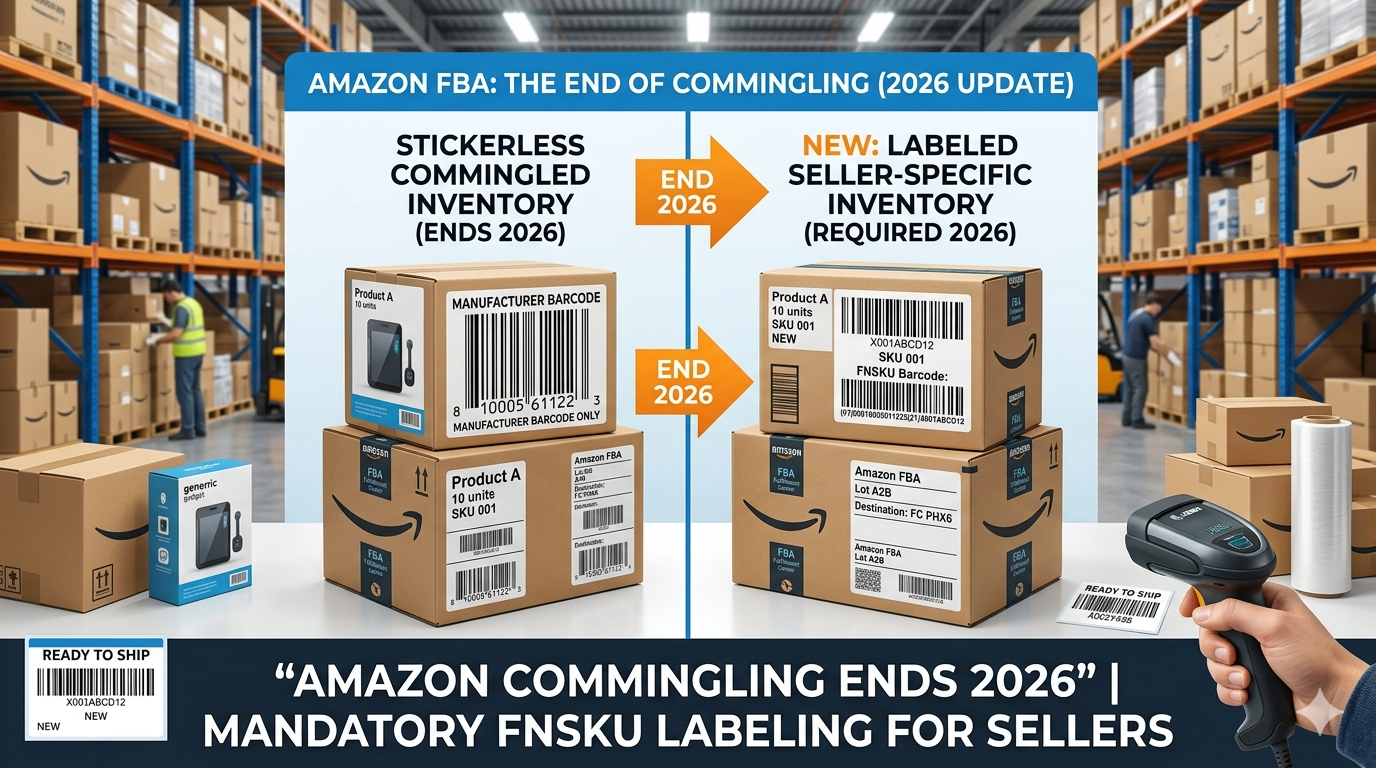
Amazon commingling ends 2026, and this change will directly impact how many sellers manage, label, and ship their inventory through FBA. For years, Amazon sellers relied on stickerless, commingled inventory to simplify operations. If your products shared the same ASIN as identical units from other sellers, Amazon could pool that inventory together and fulfill orders without requiring every unit to carry a seller-specific label. It was faster, easier, and often more cost-effective to manage.
But beginning March 31, 2026, that workflow changes in a meaningful way.
This is not just a minor backend adjustment. It affects how Amazon identifies inventory, who must apply Amazon FNSKU labels, how inbound shipments should be prepared, and what sellers need to do to avoid compliance issues. For many businesses—especially resellers, wholesalers, arbitrage sellers, and multi-source inventory operators—this shift could directly impact prep costs, receiving speed, and overall account health.
Part of the confusion is that not every seller will feel the impact in the same way right away. Some ASINs may appear unaffected at first. Brand owners and resellers won’t be treated the same, and decisions around manufacturer barcode vs. FNSKU labeling now carry much more operational weight than before.
If you sell on Amazon in any capacity, this is not an update you want to ignore or “figure out later” after shipments get delayed or inventory gets stranded.
This guide breaks down what Amazon’s commingling changes mean, who needs to relabel inventory, what brand owners can skip, and how sellers should update their FBA workflow going forward.
What Is Amazon Commingling? (And Why It’s Ending)
Understanding Amazon Commingling in Simple Terms
Amazon commingling is a fulfillment method where inventory from multiple sellers is grouped
together under the same ASIN when the products are considered identical. Instead of keeping every seller’s units physically separated, Amazon uses the manufacturer barcode—such as a UPC, EAN, or ISBN—to recognize that the products match. When a customer places an order, Amazon may ship any eligible unit from that pooled inventory, not necessarily the exact one you originally sent in.
This system is commonly known as stickerless, commingled inventory because sellers could often send products to Amazon without applying an Amazon FNSKU label to every unit. As long as the product met Amazon’s requirements for manufacturer barcode tracking, it could be received and fulfilled as part of the shared inventory pool.
Why Sellers Used Stickerless Inventory
For many sellers, commingling made FBA operations easier. It reduced prep time, simplified
shipment creation, and removed the need to label every single item before sending inventory to fulfillment centers. That made it especially attractive for resellers, wholesalers, and high-volume sellers managing large numbers of identical products across multiple SKUs.
It also helped speed up inbound logistics. With fewer labeling steps and simpler prep requirements, sellers could move inventory into Amazon’s network faster and often at a lower operational cost.
Why Amazon Is Ending It
Amazon is moving away from commingling because it creates problems around traceability, authenticity, and accountability. When inventory from multiple sellers is mixed together, it becomes harder to determine exactly which seller supplied a defective, counterfeit, damaged, or returned unit. That can create customer trust issues and make enforcement more difficult when quality problems happen.
By shifting toward tighter inventory-level identification, Amazon can better track product ownership, improve quality control, and reduce disputes around returns and authenticity.
In short, Amazon wants to know exactly whose inventory is whose — and that changes how sellers must prepare inventory.
What Happens on March 31, 2026?
Amazon Is Changing How FBA Inventory Gets Identified
Beginning March 31, 2026, Amazon is ending or heavily restricting the way commingled inventory has traditionally worked for many sellers. In simple terms, sellers will no longer be able to rely on manufacturer barcodes alone in the same way they once did for stickerless inventory. Amazon is moving toward a system where inventory must be identified with much more precision, often at the seller level rather than just the product level.
That means more sellers will need to use Amazon-specific inventory identification, most commonly through FNSKU labeling, so Amazon can clearly track which units belong to which seller.
What This Means for Sellers in Practice
Operationally, this change is bigger than it looks. Many sellers will need to update how they prep and ship inventory before it reaches Amazon’s fulfillment centers. That can include adding new labeling steps, updating prep center instructions, revising warehouse SOPs, and retraining teams involved in
shipment creation and packaging.
If sellers continue using old workflows after the deadline, they may run into receiving delays, non- compliant shipments, relabeling issues, or stranded inventory. In other words, this is not the kind of update sellers can afford to ignore until the last minute.
Not Every Seller Will Feel It the Same Way
That said, the impact won’t be identical for everyone. Resellers, private label brand owners, authorized distributors, and multi-channel sellers may each experience the shift differently depending on how their inventory is sourced, labeled, and enrolled in Amazon’s systems.
The biggest question is simple: who now needs FNSKU labels — and who doesn’t?
Who Still Needs FNSKU Labels After Commingling Ends?
What Is an FNSKU — and Why It Matters More Now
An FNSKU (Fulfillment Network Stock Keeping Unit) is Amazon’s internal barcode used to identify inventory that belongs to a specific seller. Unlike a manufacturer barcode such as a UPC or EAN, an FNSKU ties each unit directly to your Amazon seller account. That means when Amazon receives, stores, picks, ships, or processes a return, it can trace that item back to your inventory, not just the ASIN itself.
Now that Amazon is moving away from stickerless commingled workflows, that distinction becomes much more important. Instead of treating all matching inventory as one pooled group, Amazon is increasingly pushing sellers toward seller-specific inventory tracking.
Which Sellers Will Most Likely Still Need FNSKU Labels
If you sell products that you do not manufacture or own as a brand, there’s a strong chance FNSKU labeling will become your safer and more practical default. This especially applies to resellers, wholesale sellers, online arbitrage (OA) sellers, retail arbitrage (RA) sellers, and anyone listing on shared ASINs where multiple sellers compete for the same product listing.
In these cases, FNSKU labels help ensure your units are correctly attributed to your account. That matters for more than just receiving. It also protects against inventory mix-ups, improves traceability in return and authenticity disputes, and reduces the risk of being tied to another seller’s lower-
quality or questionable units.
FNSKU becomes especially important when you sell replenishable wholesale inventory, products with multiple active sellers, or items that are more vulnerable to counterfeit or condition complaints.
When You Should Treat FNSKU as Essential
If your old workflow relied mainly on manufacturer barcode tracking, this is the point where many
sellers need to rethink their prep process immediately. That includes how inventory is labeled at the source, at the warehouse, or through a prep center before it ever reaches Amazon.
You likely need FNSKU if you sell products you don’t manufacture, share listings with other sellers, use wholesale, OA, or RA sourcing models, or send inventory to FBA under common ASINs.
For resellers, FNSKU labeling is no longer just a best practice — it’s becoming the safer default.
What Brand Owners and Private Label Sellers Can Potentially Skip
Why Brand Owners May Have a Simpler Path
Not every seller will feel the end of commingling the same way. Brand owners and private label
sellers may have a much simpler transition than resellers because they usually have more control over the listing, the barcode, and the inventory source itself. If you are the sole brand owner or effectively the only seller controlling the ASIN, Amazon may not require the same level of anti- commingling protection that shared-listing sellers need.
In many cases, that means some brand owners may still be able to use manufacturer barcode
workflows or a more streamlined prep process, especially when product ownership is already clear and the inventory is consistently sourced from the same controlled supply chain.
But Brand Owners Still Need to Verify the Details
That said, this is not a “set it and forget it” situation. Even if you own the brand, you still need to confirm whether a listing is eligible for your preferred barcode workflow and whether Amazon
accepts it under your current FBA configuration. That includes checking listing eligibility, barcode acceptance, FBA prep settings, and shipment-level compliance requirements before assuming nothing has changed.
A lot of sellers make the mistake of thinking, “I own the brand, so I’m automatically fine.” Amazon doesn’t always work that cleanly.
Why FNSKU May Still Be the Smarter Option
Even when brand owners are technically allowed to skip FNSKU on certain inventory, that doesn’t always make it the best operational decision. FNSKU can still help with inventory tracking, return disputes, receiving accuracy, and prep consistency across multiple SKUs or fulfillment workflows.
And if you ever expand distribution, add resellers, or run more complex inventory operations, having a standardized labeling process can save headaches later.
Just because you can skip FNSKU on some inventory doesn’t always mean you should.
How the End of Commingling Affects Resellers the Most
Why Resellers Feel the Biggest Impact
Resellers are the group most directly affected by the end of commingling because their entire business model often depends on selling products from the shared Amazon catalog. Unlike brand owners, resellers typically rely on manufacturer barcodes and list against ASINs where multiple
sellers compete. It’s also common for resellers to source the same product from different distributors, which adds another layer of complexity when inventory is no longer pooled together.
Once commingling is restricted, Amazon expects clearer seller-level identification. That puts
immediate pressure on resellers to tighten how inventory is labeled, tracked, and prepared before it ever reaches fulfillment centers.
New Operational Risks Resellers Must Handle
With these changes, several risk areas become more visible. Mislabeled inbound shipments can lead to receiving issues. Inventory may get delayed or flagged if it doesn’t meet updated requirements.
Disputes around authenticity can increase if product sourcing is inconsistent, and return contamination becomes harder to manage when every unit must be clearly tied to a seller.
There’s also more room for human error. Prep centers and warehouses now play a bigger role, and even small labeling mistakes can create larger downstream problems.
Why This Matters Financially
This shift increases operational load. Resellers may face higher labor costs, additional prep
requirements, and more complex workflows that depend heavily on strong SOPs. Sellers who fail to adapt early risk dealing with receiving delays, stranded inventory, compliance warnings, and unnecessary pressure on account health.
The end of commingling doesn’t kill resale models — but it does punish sloppy operations.
How Sellers Should Update Their Labeling and Shipping Process
The smartest way to handle Amazon’s commingling changes is not to “wait and see.” Sellers should treat this like an operations update and build a cleaner, more controlled workflow before inventory problems start showing up. The goal is simple: know which units need seller-specific tracking, make labeling consistent, and remove guesswork from your shipping process.
1) Review Which SKUs Need FNSKU
Start by auditing your catalog. Go SKU by SKU and separate products into two groups: brand-owned inventory and reseller or shared-ASIN inventory. This step matters because not every product in your catalog will necessarily need the same prep workflow.
You should also identify which listings previously relied on manufacturer barcode tracking. Those are the SKUs most likely to need immediate attention. If you’ve been sending products stickerless without thinking much about it, this is where you find out what needs to change first.
2) Update Your Prep SOPs
Once you know which products require FNSKU, your prep process needs to reflect that clearly. Add barcode printing rules, placement instructions, and quality checks into your SOPs so every unit is labeled correctly before shipment.
Make sure the label covers the correct scannable barcode when Amazon requires it, and standardize exactly where labels should be placed on the packaging. If this step is inconsistent, you’re inviting
receiving issues before the shipment even lands.
3) Align With Your Prep Center or Warehouse Team
If you work with a prep center, warehouse staff, 3PL, or even a VA team helping coordinate inventory, everyone involved needs to understand the updated workflow. A single small labeling error at the prep stage can create a much larger issue once the shipment is in transit or checked in by Amazon.
This is where many sellers get burned: they understand the change personally, but their backend team keeps using the old process.
4) Recheck Shipment Creation Settings in Seller Central
Before sending inventory, review your shipment creation settings inside Seller Central. Verify your label preferences, confirm how the shipment is being configured, and recheck prep requirements for the products you’re sending. Sometimes the problem isn’t the inventory itself — it’s the shipment
setup.
5) Keep Better Inventory Documentation
Stronger documentation is now part of staying compliant. Save invoices, track supplier batches, and connect shipments to sourcing records whenever possible. That gives you better traceability if
Amazon ever questions authenticity, condition, or inventory ownership.
In 2026, Amazon sellers need tighter backend operations — not just better product sourcing.
Common Seller Mistakes to Avoid During the Transition
Assuming All Products Are Treated the Same
One of the biggest mistakes sellers make is thinking this change applies uniformly across their entire catalog. In reality, different ASINs and seller types may have different barcode eligibility and prep requirements. What works for one SKU may not work for another, especially if you sell a mix of
private label and reseller inventory.
Waiting Until Inventory Problems Happen
Many sellers take a reactive approach. They only start fixing their process after they face receiving delays, stranded inventory, or listing issues. By that point, the cost is already higher—both in time and money. This transition rewards sellers who prepare early, not those who wait for problems to force action.
Letting Prep Teams Guess
If your prep center, warehouse staff, or VA team does not have a clearly documented process, mistakes will multiply quickly. Label placement, barcode coverage, and shipment prep rules need to be standardized. Guesswork at the prep stage leads to avoidable errors that show up later in
Amazon’s fulfillment centers.
Ignoring Traceability
Traceability is no longer optional. Sellers who fail to maintain proper invoices, supplier records, and batch tracking will struggle if issues arise. Whether it’s an authenticity complaint or a receiving
discrepancy, having clean documentation can make the difference between a quick resolution and a major disruption.
Thinking This Is “Just a Label Issue”
This is not just about adding stickers to products. It’s an operations, compliance, and inventory control shift. Sellers who treat it casually risk ongoing inefficiencies and repeated issues.
The sellers who handle this best won’t just be compliant — they’ll be operationally stronger than competitors who treat it casually.
Should Sellers Move More Inventory to FBM or Keep Using FBA?
This Change Doesn’t Make FBA “Bad” — It Makes Strategy More Important
The end of commingling does not mean FBA suddenly stops making sense. Amazon FBA is still extremely valuable for sellers who want Prime eligibility, faster fulfillment, and less day-to-day
shipping responsibility. But what this update does change is how carefully sellers need to think about which products truly belong in FBA.
Instead of sending everything to Amazon by default, sellers now need to look more closely at margin, prep complexity, inventory control, and return risk before deciding how each SKU should be fulfilled.
Why Some Sellers May Shift Toward FBM or Hybrid
For some products, especially lower-margin or operationally messy SKUs, the extra labeling and prep requirements may reduce the value of using FBA. In those cases, FBM can offer more control and fewer fulfillment-layer complications.
A smarter approach for many sellers will be a hybrid model. That could mean keeping fast-moving, clean, easy-to-manage products in FBA while moving difficult, fragile, slower-moving, or lower- margin SKUs to FBM. This gives sellers more flexibility without abandoning FBA altogether.
The Bigger Strategic Shift
What Amazon is really doing here is pushing sellers toward a more intentional fulfillment strategy instead of a one-size-fits-all model.
If you want to go deeper into that decision, this is a great place to internally link to your related article: FBA vs FBM vs Hybrid in 2026.
Final Verdict: What Amazon Sellers Should Do Now
Amazon’s commingling changes are bigger than they first appear. At the core, this shift is really about four things: control, traceability, compliance, and cleaner inventory attribution. Amazon wants
tighter visibility into whose inventory is entering the network, how it is being tracked, and who is responsible when issues happen.
For resellers, this means FNSKU labeling should now be treated as a serious operational priority—not a minor prep detail. If you sell shared catalog products, source from distributors, or rely on
manufacturer barcode workflows, this is the time to tighten your backend process before small issues become expensive ones.
For brand owners and private label sellers, the path may be simpler in some cases, but that does not mean you should assume you are exempt. You still need to verify barcode eligibility, prep settings, and shipment compliance on a SKU-by-SKU basis.
The sellers who will handle this transition best are the ones who update their SOPs early, align their prep and warehouse process, and build stronger inventory documentation before problems show up.
In 2026, successful Amazon operations won’t just depend on what you sell.
They’ll depend on how accurately your inventory is identified, tracked, and shipped.
What is Amazon commingled inventory?
Amazon commingled inventory is a system where identical products from multiple sellers are pooled together under the same ASIN. Instead of shipping the exact unit you sent in, Amazon may fulfill a customer order using any eligible matching unit from that shared inventory pool.
Do I need FNSKU labels after March 31, 2026?
In many cases, yes—especially if you are a reseller, wholesale seller, online arbitrage seller, or anyone listing on shared ASINs. Whether you need FNSKU labels depends on your seller type, barcode
eligibility, and listing setup, but for many sellers, FNSKU is becoming the safer default.
Can private label sellers still use manufacturer barcodes?
In some cases, yes. If you own the brand, control the listing, and meet Amazon’s barcode and prep eligibility requirements, manufacturer barcode workflows may still be possible. However, sellers
should not assume this automatically applies to all products and should verify it carefully inside their FBA setup.
Does this change affect FBM sellers too?
This update mainly affects FBA inventory preparation, inbound shipping, and barcode-based fulfillment workflows. However, even FBM sellers may feel indirect effects if they use mixed fulfillment strategies, shared catalog listings, or switch inventory between FBM and FBA.
What happens if my Amazon inventory is labeled incorrectly?
Incorrect labeling can lead to receiving delays, inventory check-in issues, relabeling requirements, shipment problems, stranded units, or broader compliance concerns. In some cases, repeated operational mistakes can also create unnecessary pressure on account health and inventory performance.