FBA vs FBM vs Hybrid in 2026: Choosing the Right Fulfillment Model as Amazon Fees Rise
FBA vs FBM 2026 is one of the biggest decisions Amazon sellers will face this year. Rising storage fees, inbound placement costs, return expenses, and tighter margins are forcing sellers to rethink how they fulfill orders. They also need to rethink how much those decisions are really costing them.
For years, many brands defaulted to Amazon FBA because it offered scalability, Prime eligibility, and hands-off logistics. But in today’s fee-heavy environment, relying on FBA without reviewing the numbers can quietly eat into profits.
This shift matters even more for sellers dealing with bulky products, seasonal inventory, slow-moving SKUs, or products with already thin margins. In many cases, what worked in 2023 or 2024 simply doesn’t make financial sense anymore.
That’s why more sellers are now comparing FBA, FBM, and hybrid fulfillment strategies with a more strategic mindset.
In this guide, we’ll break down what each fulfillment model actually means. We’ll also cover the pros and cons of each option, when each one makes the most sense, and how to choose the right Amazon fulfillment strategy based on your margins, inventory, and stage of growth.
If you sell on Amazon, this is a decision you can’t afford to ignore.
Why Fulfillment Strategy Matters More in 2026
Rising Amazon Fees Are Shrinking Seller Margins
In 2026, fulfillment is no longer just an operational backend choice—it’s a direct driver of Amazon seller profitability.
For many sellers, the real challenge is no longer just generating sales. It’s keeping enough margin after Amazon takes its share. Rising Amazon fulfillment costs are putting pressure on nearly every stage of the order process, and sellers who ignore those costs are often the ones wondering why revenue looks healthy but profits don’t.
Today, sellers must deal with a wide range of Amazon fees in 2026, including increasing storage fees, stricter inventory performance pressure, low inventory level fees, placement fees for distributing inventory across fulfillment centers, rising return processing costs, and additional prep and compliance charges depending on the product.
Each of these costs may seem small individually—but together, they can significantly eat into profits.
Fulfillment Impacts More Than Just Delivery
Your fulfillment strategy doesn’t just affect how orders are shipped—it shapes your entire business performance.
It directly influences your profit margins, your ability to offer fast shipping, your chances of winning the Buy Box, and the overall customer experience. It also determines how flexible you are with inventory—whether you can quickly react to demand changes, avoid overstock penalties, or manage seasonal products effectively.
That’s why the old “set it and forget it” approach no longer works.
In 2026, successful sellers are moving away from a one-size-fits-all model. Instead, they are optimizing fulfillment SKU by SKU—choosing between FBA, FBM, or hybrid fulfillment based on product size, margins, demand patterns, and risk.
This shift isn’t optional anymore—it’s essential for staying profitable.
What Is FBA? (Fulfillment by Amazon)
How Amazon FBA Works
Fulfillment by Amazon (FBA) is a model where the seller sends inventory to Amazon’s fulfillment centers, and Amazon takes care of most of the order fulfillment process.
Once your stock is checked into Amazon’s network, Amazon handles storage, picking and packing, shipping, customer service, and even returns. In simple terms, you focus on sourcing and selling the product, while Amazon handles the logistics after the order is placed.
This is one of the main reasons FBA became the default choice for so many sellers. It removes a lot of the day-to-day operational burden and makes it easier to run an Amazon business without building your own fulfillment setup.
FBA Pros and Cons in 2026
The biggest advantage of FBA is speed and convenience. Products fulfilled by Amazon often get the Prime badge, which can improve visibility and conversion rates significantly. It also helps sellers offer fast delivery, build stronger customer trust, and scale more easily without personally managing shipping operations.
But in 2026, FBA is no longer automatically the most profitable option.
Rising FBA fees, placement fees, long-term storage costs, and increasing return-related expenses have made it more expensive than ever for many sellers. It also gives sellers less control over how inventory is stored, handled, or reimbursed. For oversized, slow-moving, or low-margin products, FBA can quickly become a margin killer. Return abuse can also create additional hidden losses.
FBA works best when your products sell quickly, have healthy margins, are small and lightweight, and you want to grow without managing complex logistics yourself.
What Is FBM? (Fulfilled by Merchant)
How Amazon FBM Works
Fulfilled by Merchant (FBM) is a fulfillment model where the seller stores inventory and ships orders directly to customers instead of sending stock to Amazon warehouses.
With FBM, you are responsible for managing the fulfillment process after a sale happens. That means you handle inventory storage, packing, shipping, and often returns and customer support as well. Sellers can fulfill orders from their own warehouse, a home or office setup, or through a third-party logistics provider (3PL).
This model gives sellers much more control over how products are stored and shipped. It also allows more flexibility in packaging, branding, and inventory decisions compared to FBA.
FBM Pros and Cons in 2026
One of the biggest advantages of FBM is cost control. Sellers can avoid many of the rising Amazon storage fees, placement fees, and other FBA-related charges that have become more painful in 2026. FBM often works especially well for bulky, heavy, or slow-moving products that would be expensive to keep inside Amazon’s fulfillment network. In some cases, this can lead to better margins and more efficient inventory management.
However, FBM also comes with trade-offs.
If your shipping operations are not strong, fulfillment can be slower and less consistent. That can make it harder to compete with Prime listings unless you qualify for Seller Fulfilled Prime. FBM also means the seller must handle returns, delivery issues, and customer service directly, which adds more operational complexity.
FBM works best when products are oversized or heavy, inventory moves more slowly, margins are too tight for FBA fees, and the seller already has reliable logistics systems in place.
What Is Hybrid Fulfillment?
How Hybrid Fulfillment Works
Hybrid fulfillment means using both FBA and FBM strategically instead of relying fully on just one model.
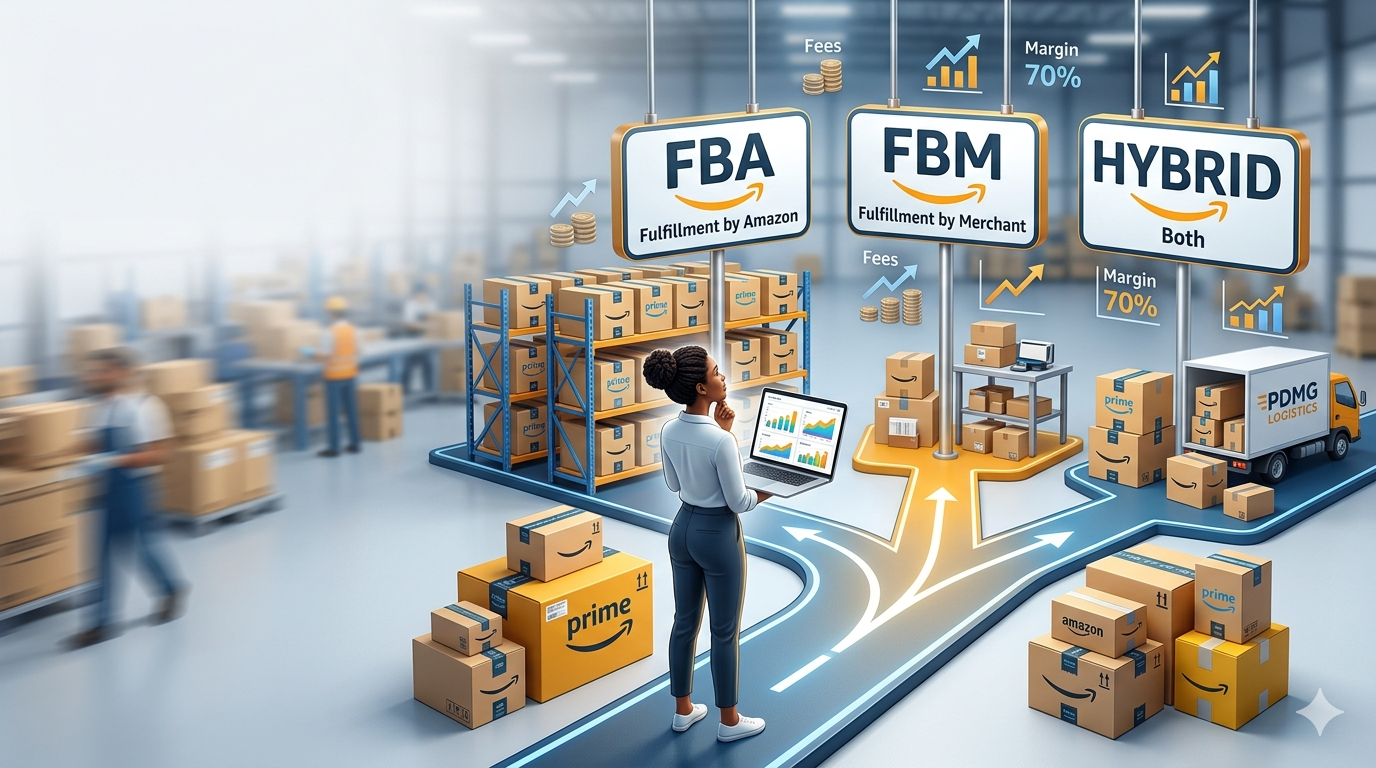
Rather than treating fulfillment as an all-or-nothing decision, sellers use each method where it makes the most sense. For example, a seller might keep fast-moving SKUs in FBA for speed and Prime visibility, while handling slower-moving products through FBM to avoid unnecessary storage fees. Some sellers use FBA for smaller, lightweight products and FBM for oversized or bulky items. Others use FBA for Amazon orders while keeping inventory in an external warehouse for multichannel fulfillment across Shopify, Walmart, or other platforms.
Another common strategy is using FBM as a backup when FBA inventory runs low or goes out of stock, helping sellers avoid lost sales and listing downtime.
Why More Sellers Are Going Hybrid in 2026
In 2026, more Amazon sellers are moving toward a hybrid fulfillment strategy because it offers a better balance between growth, cost control, and operational flexibility.
As Amazon fees continue rising, sellers can no longer afford to place every SKU into the same system without evaluating the financial impact. Hybrid fulfillment helps reduce risk, improve in-stock rates, and give sellers more control over storage costs, placement fees, and overall margins. It also prevents sellers from becoming too dependent on a single fulfillment channel.
That flexibility matters more than ever.
Hybrid works best when a seller has multiple SKUs, wants more control over operations, is actively scaling, and needs to manage inventory and fees more strategically across different product types.
For many brands, hybrid is no longer a backup plan—it’s becoming the smartest long-term Amazon fulfillment model.
FBA vs FBM vs Hybrid: Key Differences at a Glance
How These Fulfillment Models Compare
When comparing FBA vs FBM vs Hybrid, the biggest mistake sellers make is asking, “Which one is best?” The better question is: Which one makes the most sense for my products and margins?
From a cost perspective, FBA usually comes with higher Amazon fees, but it offers convenience and automation. FBM reduces many Amazon-related fulfillment costs, but shifts more responsibility to the seller. Hybrid fulfillment sits in the middle, allowing sellers to optimize costs SKU by SKU instead of applying one model to everything.
In terms of control, FBA gives sellers the least flexibility because Amazon manages storage, handling, and fulfillment. FBM offers the most control over inventory, packaging, and shipping decisions. Hybrid gives sellers a balanced setup—control where it matters, and convenience where it helps.
For shipping speed, FBA is usually the fastest and strongest for Prime conversion. FBM depends entirely on how strong the seller’s logistics operation is. Hybrid gives flexibility by combining fast fulfillment for key SKUs with cost-efficient handling for others.
Which Model Performs Best for Growth and Profitability?
When it comes to scalability, FBA is often the easiest to grow with because Amazon handles the operational load. FBM can become difficult to scale without strong systems, staff, or a reliable 3PL. Hybrid often becomes the smartest long-term option because it supports growth without forcing every product into the same cost structure.
The same applies to returns and customer service. With FBA, Amazon handles most of it. With FBM, the seller manages it directly. With hybrid, that responsibility is split depending on how each SKU is fulfilled.
And when it comes to profitability, there is no universal winner.
The best fulfillment model depends heavily on your product size, profit margins, sales velocity, and return rate. That’s why in 2026, the right decision is no longer based on convenience alone—it’s based on business economics.
When FBA Makes the Most Sense in 2026
Best Product Types for FBA
Even with rising fees, Amazon FBA is still one of the most powerful fulfillment models in 2026—but only when the numbers make sense.
FBA works best for products that are small, lightweight, and fast-moving, where the convenience and conversion benefits outweigh the added costs. If your product sells consistently and doesn’t sit in storage for too long, FBA can still help you scale efficiently while keeping operations simple.
This model is especially effective for sellers in competitive categories where the Prime badge can significantly improve click-through rates and conversions. In those cases, faster shipping and stronger customer trust can justify the higher fees.
Good examples include beauty products, supplements, small kitchen accessories, phone accessories, and fast-moving household products—items that are easy to store, cheap to ship, and often bought frequently.
When FBM Is More Profitable Than FBA
FBM becomes especially valuable when you’re dealing with low-margin SKUs or inventory that doesn’t turn fast enough to justify FBA storage and handling fees.
If you already have a reliable warehouse setup, home-based shipping process, or a dependable 3PL partner, FBM can help you keep more control over costs while protecting profitability.
In many cases, FBM is not the “weaker” option—it’s simply the more financially sound one.
If a product is expensive to store, expensive to ship through Amazon, or unlikely to move quickly, FBM can be the smarter fulfillment strategy in 2026.
Why More Sellers Are Moving to a Hybrid Model
Hybrid Is Becoming the Smarter Default Strategy
In 2026, hybrid fulfillment is no longer just a backup plan—it’s becoming the default smart strategy for serious Amazon sellers.
Why? Because sellers are realizing that no single fulfillment model works equally well for every product. Some SKUs benefit from Prime eligibility and faster delivery through FBA, while others become less profitable the moment Amazon storage, placement, and return fees start piling up.
That’s where hybrid wins.
It allows sellers to keep their top-performing SKUs in FBA for speed and conversion while using FBM for slower, bulkier, lower-margin, or higher-risk inventory. This creates a more balanced and resilient fulfillment system without forcing the entire catalog into one cost structure.
Why Hybrid Gives Sellers More Control in 2026
The biggest reason more sellers are switching to hybrid is simple: it gives them more control over profitability, inventory, and risk.
A hybrid setup helps reduce overdependence on Amazon’s fulfillment network, protects margins, improves inventory balancing, and gives sellers a backup option during FBA stockouts or inbound delays. It also reduces total exposure to rising Amazon fees while supporting multichannel growth beyond just Amazon.
And perhaps the biggest mindset shift is this:
Many profitable sellers are no longer asking,
“Should I be an FBA seller or an FBM seller?”
They’re asking,
“Which fulfillment model is best for this SKU?”
That question leads to smarter decisions—and in 2026, smarter fulfillment decisions are often what separate profitable sellers from unprofitable ones.
How to Choose the Right Fulfillment Model for Your Business
Evaluate the Numbers Before You Choose
The right fulfillment model depends less on opinion and more on economics. In 2026, smart sellers are choosing fulfillment based on what each SKU can actually support.
Start with profit margin. If Amazon’s fees leave too little room after product cost, shipping, ads, and returns, then FBA may not be sustainable. Next, look at product size and weight. Larger or heavier products often perform better under FBM because FBA storage and shipping fees can get expensive fast.
Then evaluate sales velocity. Fast-moving products are usually better suited for FBA because they justify storage and benefit more from Prime conversion. Slower-moving inventory is often safer in FBM, where you’re less exposed to storage-related costs.
You should also look closely at return rate. Products with high return frequency can become much more expensive in FBA due to return processing and damaged inventory risk.
Use a SKU-by-SKU Decision Framework
Beyond product economics, you also need to assess your operational capability. Can you reliably ship quickly, manage customer issues, and process returns without hurting customer experience? If not, FBA may still be the easier path. But if you already have systems or a solid 3PL, FBM becomes much more realistic.
Your stage of business matters too. New sellers often prefer the simplicity of FBA, while growing brands benefit more from hybrid optimization as their catalog expands.
A practical way to decide is to ask these four questions for every SKU:
- Does this SKU need Prime to convert?
- Can I afford FBA fees on this SKU?
- Is this product selling fast enough to justify Amazon storage?
- Would FBM protect my margin better?
If you answer those honestly, the right Amazon fulfillment model usually becomes much clearer.
Common Fulfillment Mistakes Amazon Sellers Make
The Most Common Fulfillment Decisions That Hurt Profitability
One of the biggest mistakes Amazon sellers make is using FBA for every SKU without questioning whether it actually makes financial sense. Just because FBA is convenient doesn’t mean it’s always profitable.
Many sellers also underestimate the impact of hidden Amazon fees—including storage, placement, return processing, and prep-related costs. These fees may not seem dramatic at first, but over time, they can quietly erode margins and turn “good-selling” products into weak performers.
Another major mistake is failing to review profitability at the SKU level. A seller may think their business is doing well overall, while several products are actually losing money due to poor fulfillment choices.
Why Fulfillment Needs a Smarter Strategy in 2026
Sellers also run into problems when they send too much inventory into FBA, especially for products with slower turnover or seasonal demand. That often leads to unnecessary storage costs and overstock pressure.
Another costly mistake is not having an FBM backup. If your FBA inventory goes out of stock or gets delayed, having no secondary fulfillment option can lead to lost sales and ranking drops.
And perhaps the biggest mistake of all? Choosing fulfillment based only on convenience.
In 2026, fulfillment is not just logistics. It’s part of your pricing strategy, your profit margin, and in many cases, your long-term survival on Amazon.
Final Verdict: FBA, FBM, or Hybrid?
The Right Fulfillment Model Depends on What You’re Selling
If your goal is faster scaling, Prime visibility, and simpler day-to-day operations, FBA can still be a strong option—especially for small, fast-moving products with healthy margins.
If you need more control over inventory, packaging, and cost structure, FBM may be the better fit. It often makes more sense for oversized, fragile, slow-moving, or lower-margin products where Amazon’s fees can quickly hurt profitability.
And if you want the most flexible, resilient, and financially smart setup, hybrid fulfillment is often the strongest long-term strategy. It allows you to use FBA where speed and conversion matter most, while using FBM where margin protection matters more.
What Winning Sellers Will Do in 2026
The sellers who win in 2026 won’t be the ones who fulfill the fastest alone.
They’ll be the ones who fulfill most profitably and strategically.
That means now is the right time to audit your SKU-level profitability, reassess how rising Amazon fees are affecting your margins, and build a fulfillment strategy that supports both growth and long-term sustainability.
Because in today’s Amazon environment, fulfillment is no longer just an operations decision—it’s a business strategy.